
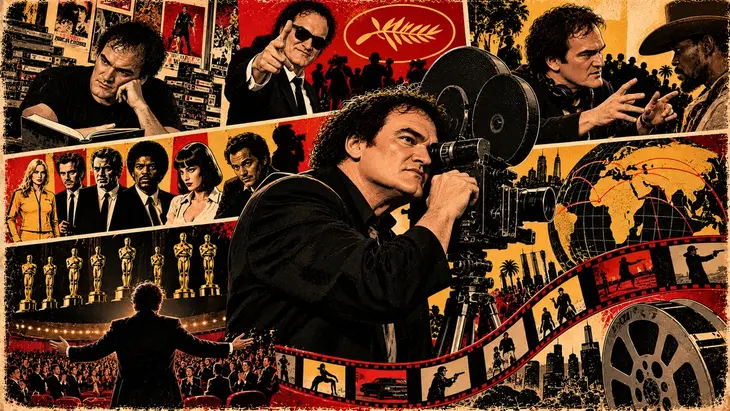
Quentin Tarantino's professional path is best understood by looking at which decisions made each stage of his career possible. Writing a screenplay and getting to direct it offer a different position from selling a script that another filmmaker will bring to the screen. After a hit, choosing the next project means responding to audience and studio expectations, as well as deciding what kind of film one wants to make.
The relationship with the industry appears in concrete matters: casting choices, the search for partners, and preparation for a release. One creative decision can affect how a film is marketed; the ability to attract audiences can, in turn, give a director's proposal more weight. Those relationships change with each project and require attention to the available agreements and accounts.
Tarantino's public conversations make it possible to see how he explains some of his choices. Studio announcements show another part of the process, from committing to a project to promoting it. Together, these perspectives describe a career built through specific films and collaborations that take different forms.
Recognition for one film can have different effects on the next one. It helps a project be heard, but it also creates expectations about its cast, scale, or tone. Tarantino's career offers several moments in which those expectations coexist with decisions to change direction.
Entering the industry with a recognizable voice
In the conversation published by BAFTA on November 14, 2019, Tarantino emphasized that Reservoir Dogs was made before other scripts he had written. By directing it, he could present himself to the industry as a director, while his scripts were also beginning to become films by other filmmakers. That order was significant for his entry into 1990s independent film: his writing reached the public alongside a work directed by him.
The difference has professional consequences. A screenplay circulates among potential collaborators and allows them to assess characters, scenes, and structure. A finished film also shows how its maker organizes the cast, space, and time of each sequence. Those decisions give future partners a concrete reference for imagining another project. The work already done becomes part of the conversation about what could be made next.
Reception can also influence people who have not yet directed a film. In a testimony published by Sundance on October 23, 2025, documentary filmmaker Jesse Moss credited Reservoir Dogs with part of the impulse that led him to pursue filmmaking. It is an individual experience identified within the influence of Tarantino on other filmmakers. It documents the effect of a film on a viewer who later made films, without making that proof that they shared the same style.
Choosing the next project and defending its cast
In that 2019 BAFTA conversation, Tarantino explained that with Jackie Brown he had consciously chosen to move away from the expectation that he would top Pulp Fiction. He considered its success to be a phenomenon that would be difficult to repeat. The decision to move on to a different kind of film shows how extraordinary recognition can create a creative problem: what to do when comparison with the previous work seems unavoidable.
Casting was another site of negotiation. Speaking to Charlie Rose on December 26, 1997, Tarantino recalled conversations with his partners about the commercial appeal of certain actors. He described them as debatable proposals, also tied to international sales. In Jackie Brown, he argued that Pam Grier was the right performer for the role. His explanation places the artistic choice within a dialogue about the film's commercial conditions.
A conversation about a specific name does not by itself describe all the conditions of a director's control. Casting, runtime, and approval of the final cut can raise different questions. To understand creative control and the final cut in Tarantino's career, it is important to distinguish which decision is being considered. Defending an actress explains a casting choice; the authority over the version that reaches the public needs its own context.
The partnership with Sony and the promotional use of his name
On February 28, 2018, Sony Pictures announced Once Upon a Time in Hollywood with Leonardo DiCaprio and Brad Pitt. The announcement made public a specific combination of director, project, and stars. The relationship between Tarantino and Sony Pictures places another stage of his career: a company presented his next film as its own proposal within its release slate.
The collaboration also extended to promotion through other films. On July 15, 2019, Sony announced a ten-title television series of Columbia films selected by Tarantino to accompany the release of Once Upon a Time in Hollywood. The initiative included conversations with critic Kim Morgan. His knowledge of the catalog was thus incorporated into a campaign that linked the new feature film with the cinema of earlier eras.
That case makes it possible to observe the use of Tarantino's name as commercial presentation. Viewers could encounter his film and, at the same time, a selection of works presented under his name. The association connected a new release with a catalog that was still circulating. The signature functioned as an invitation to view those films from a particular perspective, without attributing to him the direction of the selected works.
His career thus brings together decisions about what gets filmed and about how it is presented to the public. Changing projects after a success, defending a performer, and a campaign built around a catalog are different actions. Each shows a form of relationship between the filmmaker's preferences and the possibilities offered by his industry partners.
A film's circulation also depends on territory and exhibition medium. The BBFC record for Reservoir Dogs notes a theatrical classification dated June 25, 1992, linked to Rank Film Distributors, and another for home video dated May 4, 1995, linked to Polygram Video. These are dated actions by the British body for different uses; classification dates do not automatically match release or sale dates.
This distinction makes it possible to follow a dimension of a career that does not appear in a simple list of titles. A film can reach different audiences at separate times and through different distributors. Its reception unfolds under those conditions: some viewers know it in a theater and others through a home edition. Keeping the reference to territory and format avoids mixing processes that have their own participants and schedules. It also helps explain why the public memory of a work can be built over years after its first showing.