
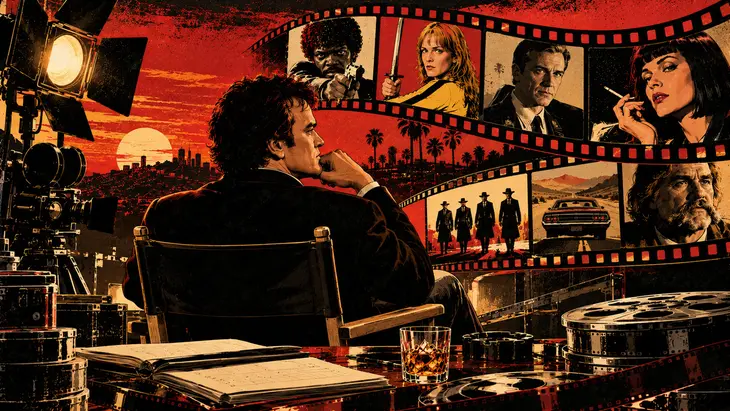
Quentin Tarantino’s biography brings together several professions: aspiring actor, video store clerk, screenwriter, director, and writer on film. That variety helps explain a career in which talking about movies goes hand in hand with making them. His characters talk about songs, TV shows, and shared experiences; his stories draw on devices from very different genres. Film education and professional work are connected, although knowing an influence is not enough to explain every decision in a film.
His move into directing was not an isolated leap from the video store to recognition. There was writing, earlier projects, and meetings with collaborators, as well as support and exhibition spaces such as Sundance. Later on, awards coexisted with literary adaptations, television work, and films on different scales. The timeline makes it possible to place each change without turning it into an inevitable march toward success. It also distinguishes the work from public life: a release date, a role at a festival, and a family event belong to different dimensions of the same career.
Quentin Tarantino built his career by moving from intense fandom to the shared work of making movies. Writing has a constant place in that journey, but his early years also include acting training and jobs tied to film exhibition and rental. The image of the director who learned by watching movies is incomplete if it leaves out practice, projects that never got finished, and the people who made the next steps possible.
Training and entry into film
The Biography profile places his birth on March 27, 1963, in Knoxville, Tennessee, and his later childhood in California. It also documents his acting classes and his job at Video Archives in Manhattan Beach, where he worked with Roger Avary. The origins and training of Tarantino thus combine the experiences of viewer, conversationalist, and actor. The video store was a place for exchange and access to movies; crediting it alone with an entire directing technique oversimplifies that education.
The Sundance timeline records his participation in the directing lab in 1991 and the premiere of Reservoir Dogs at the festival in 1992. It is worth distinguishing the two moments: developing a film with support and showing a finished work are different stages. The debut establishes a professional collaboration and a recognizable way of telling stories, with delayed information, characters vying for authority, and conversations capable of changing the balance of a scene.
Tarantino’s film buffery also includes selection and commentary work. His familiarity with westerns, crime films, and martial arts movies provides a repertoire of situations and forms. That culture is more revealing when it is linked to concrete choices, such as stretching out a wait or changing registers, than when it is presented as a catalog of titles supposedly hidden in every shot.
Scripts, directing, and changes in scale
A film credit makes it possible to pinpoint its place in the trajectory. True Romance, directed by Tony Scott, belongs to his work as a screenwriter; Jackie Brown shows his adaptation work based on Elmore Leonard. The professional path in the film industry brings these responsibilities together without equating writing, directing, producing, and appearing as an actor. Each role involves a different kind of participation in the final form of a work.
The sequence of Quentin Tarantino films makes it possible to identify changes without reducing them to a decade-by-decade classification. Reservoir Dogs concentrates conflict in a group under pressure; Pulp Fiction intertwines stories; Kill Bill unfolds a revenge story in two volumes. Later, war and the western broaden the frame of his stories. They are variations in scale, setting, and genre, with continuities in dialogue and in the way information is distributed between characters and viewers.
His writing activity adds another perspective. Cinema Speculation, presented by its publisher as a blend of memories and film reflection, shows the viewer commenting on the movies he has seen. It is a form of self-representation: the author selects experiences and organizes his arguments. It helps us understand his point of view, while the credits, releases, and award records document other aspects of his career.
Recognition and public life
The Cannes record lists the Palme d’Or for Pulp Fiction in 1994. The Academy of Motion Picture Arts and Sciences records the Original Screenplay award for that film at the 1995 ceremony, with screenplay by Tarantino and story by Tarantino and Roger Avary; in 2013 it honored his writing for Django Unchained. The awards of Quentin Tarantino need to preserve these dates and attributions. His 2004 presidency of the Cannes jury, recorded in the festival archive, was a responsibility involving selection and deliberation.
The personal life of Quentin Tarantino includes dated public facts, such as his marriage to Daniella Pick in 2018, noted by Biography. Those facts do not justify explaining a scene through assumptions about his relationships. In a career so widely discussed, separating statements, verifiable events, and critical interpretation makes it possible to understand both the public figure and the film work more precisely.
Television offers a less visible side of his work as a director. The BFI lists the episode Motherhood of ER, from 1995, and the two-part episode Grave Danger of CSI, from 2005. The Television Academy records a nomination for directing a drama series for that last one in 2005. The nomination documents recognition within that medium, without amounting to a win.
Working within a series means dealing with characters, actors, and relationships that have already been developed. The episode needs to fit into a context that the regular audience knows, even if it allows for variations in pace or intensity. This experience adds a different scale from that of a feature film conceived around an original script.
It also makes it possible to appreciate directing as an activity that responds to concrete conditions. The continuity of a hospital or a team of investigators provides a recognizable framework; the organization of scenes determines how each conflict is experienced within it. These assignments broaden a professional trajectory beyond theatrical film releases.