
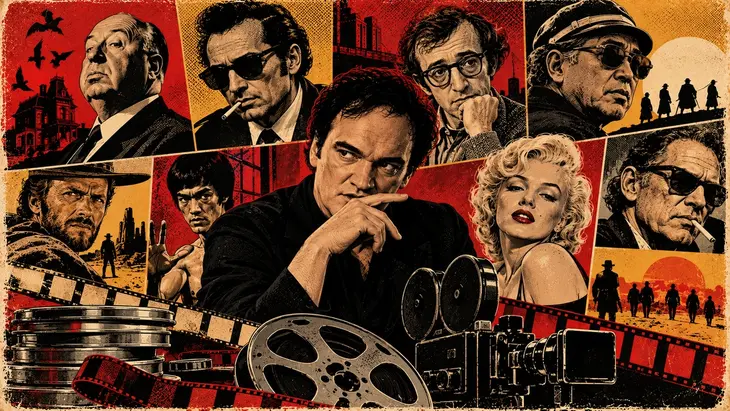
Quentin Tarantino's admiration for other filmmakers opens up a conversation about the work a film does. A director distributes attention: deciding when to acknowledge a face, how long to hold a meeting, and what part of the space stays offscreen. A performer inhabits those decisions with a voice, a posture, and a way of reacting. The result makes it possible to remember a personality even when the details of the plot have faded.
Between praise for visual style and enthusiasm for an actor lies shared ground: the ability to give a scene a life of its own. Expressiveness can arise from careful composition, from a conversation that seems to linger, or from a supporting presence that changes the energy of the cast. Tarantino's comments offer examples of those forms of attention. Some explain a youthful fascination; others focus on a specific editing or performance choice. Comparing them makes it possible to recognize different pleasures: anticipating a director's invention, enjoying the company of certain characters, or discovering how much a brief performance contributes.
In his 2008 Cannes masterclass, Tarantino named Brian De Palma, Sergio Leone, and Howard Hawks among the directors who were decisive to his artistic formation. He also expressed admiration for Martin Scorsese.
Leone and De Palma: the power of a visual signature
He recalled Brian De Palma with fanlike enthusiasm and evoked how Sergio Leone brought Charles Bronson in and out of frame. Mise-en-scene defines relationships that the plot can only summarize. A character can dominate the shot because of size, remain apart from a group, or take time to walk through a door. Each choice alters the authority and vulnerability we perceive. Those differences make it possible to study visual style through actions: appearing, taking a place, approaching someone, or withdrawing.
The continuity of a style can reside in a way of delaying a revelation or introducing a figure before they speak. A wait in a western and a threat in a thriller can use a similar delay; the landscape, the information, and the rhythm of bodies change the effect. Formal affinity makes it possible to compare both procedures while preserving their differences in tone and situation.
Hawks and Scorsese: companionship and movement
At BAFTA in November 2019, Tarantino highlighted the pleasure of spending time with the characters in Rio Bravo, by Howard Hawks, while explaining the conception of Jackie Brown. Duration can build familiarity. Returning to a shared space allows a gesture to become a habit and a response to reveal an earlier relationship. The viewer's pleasure includes that continuity of behavior, even in the intervals between two decisive actions. A pause gives time to recognize how the people in the scene get along.
In the conversation published by the Directors Guild of America in fall 2019, Tarantino discussed with Martin Scorsese the number Happy Endings from New York, New York. He pointed out the fluidity of the transition between Francine's stage performance and her appearance in the movie. He preferred the edit that keeps that number. The praise focuses on how a sequence links two forms of representing a performance.
The company of characters and the transformation of space offer different criteria for appreciating direction. One scene may favor continuity, making it pleasant to stay; another may sustain interest through a shift in scale or perspective. Rhythm also depends on that choice between extending a situation and guiding the viewer's eye toward a new place.
Performers: praise and role choice
In his review of American Graffiti, published on New Beverly on June 29, 2022, Tarantino singles out Cindy Williams and suggests that she may deliver the cast's most accomplished characterization. In the same piece, he says he is a Bo Hopkins fan, although he questions his casting in the role he plays. Admiration for the actor coexists with an objection to the casting.
A performance and its fit with a character can be judged separately. An actor's work may be intense and precise, while their presence introduces expectations that the fiction has to resolve. The age they project, their physical relationship to the rest of the cast, and the register of their voice help define who seems to have experience, authority, or a need for recognition.
Characterization is built through visible choices: a way of waiting for an answer, taking a seat, or changing tone with another person. A supporting role can gain substance in only a few moments if those behaviors suggest a life that continues beyond the scene. Recognizing that work makes it possible to value contributions that are short in duration but crucial to the impression a cast leaves.
A performer's public image adds another layer to every appearance. Anyone who recognizes them may remember other films and anticipate a way of behaving. The new fiction works with that memory: it can confirm it, displace it, or make it uneasy. The familiar face retains its familiarity, while the character establishes its own needs and relationships. That tension explains part of the interest in seeing the same person in different roles.
Charisma also affects how we receive behavior that is hard to accept. A performance can draw attention and make a desire understandable without making the character's actions reasonable. Enjoying that expressive power means recognizing artistic work; evaluating its choices within the story requires paying attention to their consequences. Likewise, praise for a performance does not amount to approval of the performer’s personal life.
Direction shapes that response by making room for other points of view. Showing a reaction, holding a silence, or changing distance can alter how much of a charismatic figure's confidence we share. The performer’s appeal and the film’s perspective thus maintain an open relationship.