
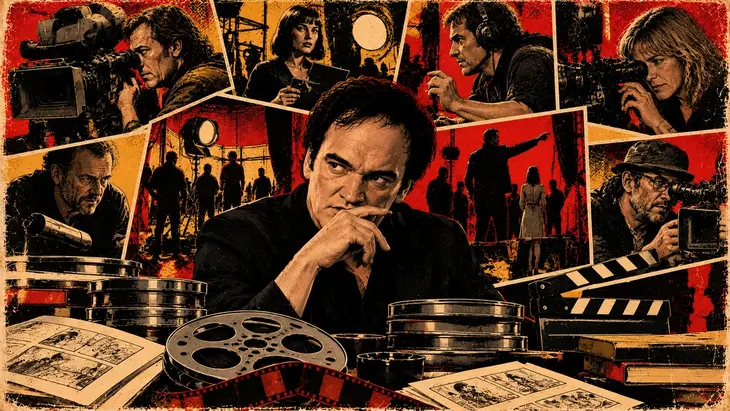
Quentin Tarantino's technical team turns the script and directing choices into concrete images and sounds. Editing chooses among takes and organizes their length. Cinematography prepares the image that can be recorded; production design builds the environment in which the characters will act. Each craft works on different materials, even though their decisions come together in the same scene.
Collaborations change from one film to another. Sally Menke and Fred Raskin held the editing role in different periods, while costume and set design require teams tied to each project. That is why it is worth connecting each name with a specific work and credit. Recognizing a visual style is not enough to identify everyone who took part in creating it.
There is also work before the camera and after filming: finding performers, preparing practical effects, or building sound environments. Accounts from the people who carried out those tasks make it possible to explain how the departments relate to one another and what each collaboration contributes.
A scene begins to take shape before it is shot and keeps changing afterward. The cast works in a space prepared for the camera; the takes move into editing and receive sound treatment. Following those tasks makes it possible to recognize decisions that the viewer experiences together.
Editing and cinematography: working with duration and image
The Cannes listing for Pulp Fiction credits Sally Menke with editing and Andrzej Sekula with cinematography. Editing means deciding which take best preserves a reaction and how long it remains on screen; cinematography means preparing how the actor, light, and space will enter the frame. A gesture can look very different depending on both decisions.
Fred Raskin explained to Slant in January 2013 that he began editing Django Unchained during filming, while Tarantino focused on shooting. He prepared an early version and became familiar with the material before working with it in the editing room. That process helps explain Fred Raskin's contribution as an editor: having concrete alternatives to test the rhythm, recover information, or remove a passage that interrupts the progression. The work requires knowing what was shot, in addition to making cuts.
In the cinematography of Django Unchained, American Cinematographer identifies Robert Richardson. The work of Richardson with Tarantino connects the intention of the shot with the conditions needed to achieve it. A camera position forces you to anticipate which walls will be seen, where the performer will move, and where the lighting can be placed. These are agreements with other departments; the director of photography does not work in a space separate from those decisions.
Spaces, costumes, and effects in front of the camera
The Academy singles out Barbara Ling's production design and Nancy Haigh's set decoration in Once Upon a Time in Hollywood. The work of Barbara Ling helps place the conception of spaces among the responsibilities that build a film. A location needs a layout compatible with the scene and details that suggest how it is used. Furniture, objects, and surfaces gain meaning within that whole, both through how they look and through the way they allow action to happen.
Costume adds information about the character and has to work during movement. Betsy Heimann told Vogue in October 2019 that she designed Vincent's suit in Pulp Fiction with a messier look and Jules's with a reference to the 1960s. That specific difference illustrates the work of Tarantino's costume designers. Sharing a general silhouette can coexist with different decisions about fabric, collar, and fit that set two characters apart.
Makeup effects prepare physical elements so they can interact with performers and camera. In an AMC interview from November 2017, Greg Nicotero recalled his participation in the effects for Reservoir Dogs. The collaboration of Greg Nicotero and KNB EFX belongs to that field. A prosthetic requires deciding what the shot will be able to show and how it will keep its appearance between takes; its presence on set also gives the actor a concrete object to react to.
Physical action involves another kind of preparation: positions, paths, and coordination between the people who perform and record the movement. Stunt work can overlap with effects and costume, because a fall or a fight changes what each department needs to anticipate. The visible continuity of the action depends on that shared preparation, along with the performance and the editing that bring the takes together.
Sound and casting: contributions that come before the final result
Wylie Stateman and Harry Cohen explained to CineMontage in September 2009 that they delivered sound proposals in advance so Tarantino and Menke could test them during editing. Stateman was the sound editing supervisor and Cohen the sound designer. The collaboration of Wylie Stateman and Harry Cohen included creating an old-fashioned texture for the propaganda film shown within Inglourious Basterds. Sound could already guide an editing decision before the final mix was reached.
Victoria Thomas identified Django Unchained and Once Upon a Time in Hollywood among her casting credits in her September 2020 interview with Casting Networks. Recognizing the casting directors makes it possible to include casting in the history of the crew. Proposing performers and assessing their suitability opens possibilities for the character. The final decision and the later directing work are part of a process in which several people take part.
The main positions rely on teams that coordinate details during each take. American Cinematographer's report on Django Unchained, published in January 2013, identifies along with Richardson the gaffer Ian Kincaid, first assistant camera Gregor Tavenner, and key grip Chris Centrella. The piece describes their working familiarity and the communication they maintained while the shots were being prepared and filmed.
That level of coordination is visible in Stephen's move toward the Candieland dining room. The report explains that the camera move coincided with the movement of a set wall and with changes in lighting. What appears to be a continuous move required the different operations to happen at the planned moment.
The example makes it possible to appreciate the collaborators who are left out of the more usual references to the director and the director of photography. Their tasks have observable effects: they leave room for movement, keep the image usable, and make it possible to repeat the shot with the actors.