
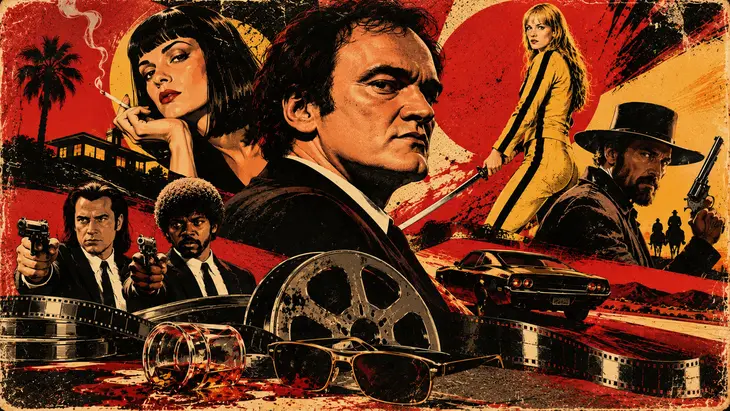
Quentin Tarantino is a film director and screenwriter whose films can turn an everyday conversation into a power struggle. His characters negotiate, play roles and tell stories, while the editing determines how much the audience knows. Crime, revenge and cinema itself often feature, although the tone shifts between the intimacy of Jackie Brown and the spectacle of Kill Bill.
His relationship with films also includes writing about them and sharing them with other viewers. This activity helps distinguish the filmmaker from the critic: an opinion about a western explains his tastes, but does not, on its own, show how he constructed a scene. Likewise, recognising a regular cast member or a familiar song raises a question that needs to be answered by looking at the particular film.
There are different ways to explore his work: follow the releases, compare techniques or look at the work of the people involved. Each perspective offers a different scale, from a film’s plot to the collaboration that makes a sequence possible. His professional career adds context about the films’ production and reception, without replacing the experience of watching them.
In Tarantino’s films, characters usually need something from one another: money, information, protection or recognition. This dependence underpins both open confrontations and seemingly calm conversations. The differences between the films are just as revealing as their shared features.
Films and storytelling
The journey through Quentin Tarantino’s films begins with the crime stories of Reservoir Dogs and Pulp Fiction, then expands into other genres and eras. Jackie Brown adapts an Elmore Leonard novel; Kill Bill builds a revenge story across two volumes; Once Upon a Time in Hollywood follows entertainment professionals in a changing environment. The films offer a chance to appreciate different scales of production and different ways of sharing the spotlight. It is also worth distinguishing the films he directs from scripts filmed by other directors.
Tarantino’s filmmaking style can be recognised in specific choices: delaying a piece of information, holding an uncomfortable silence or pairing a cheerful song with a threatening situation. Violence may come after a long wait, while the framing keeps several people in view. These techniques are best studied by considering their effect in each scene. A story told in chapters and a relationship between characters from different films address different questions: the first concerns narrative; the second, fictional continuity.
A director who also discusses and screens films
Tarantino’s cinephilia has a public expression in his essays, conversations and screening projects. Cinema Speculation combines memories as a viewer with film criticism, while The Video Archives Podcast brings Tarantino and Roger Avary together to discuss films, with Gala Avary credited as producer in the programme’s official presentation. These sources help put his opinions in context. A film praised in a signed piece has a verifiable attribution; a visual resemblance proposed by a critic needs to be presented as an interpretation.
The people and career behind the films
Tarantino’s collaborators work across different areas, from acting to editing, cinematography and music supervision. The Cannes archive’s entry for Pulp Fiction credits Andrzej Sekuła with cinematography and Sally Menke with editing. Knowing these roles helps us appreciate how visual continuity is created or the pace of a conversation is adjusted. Recurring performers provide another kind of continuity: a familiar face can take on a different dramatic role without their characters sharing an identity.
Tarantino’s biography places his education and professional activities alongside documented events in the reception of his work. Sundance recalls the screening of Reservoir Dogs at its 1992 festival; the Cannes archive records the Palme d’Or for Pulp Fiction in 1994. These are different kinds of events: one relates to a film’s initial circulation and the other to an award. Linking dates, works and honours helps explain his career without turning every public anecdote into an explanation of his artistic decisions.
The title of a film can vary between Spanish-speaking countries. To identify it precisely, it helps to include the original title, year and director as well. Malditos Bastardos and Inglourious Basterds refer to the same film; a change in its commercial title does not mean it is a different film. This approach is especially useful when comparing editions, translated interviews or references from other regions.
Two dates are also often confused: the release date and the period in which the story is set. A film set in the past is, as a production, a product of the time when it was made. Its costumes and sets are part of a reconstruction that may combine research and invention. That is why a real person shown on screen requires more context than simply identifying the actor.
The title of an essay or chapter does not guarantee that all its content is factual, either. Hypotheses, personal recollections and critical opinions should be read according to their nature and the source presenting them.