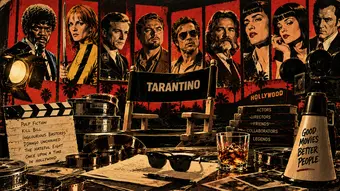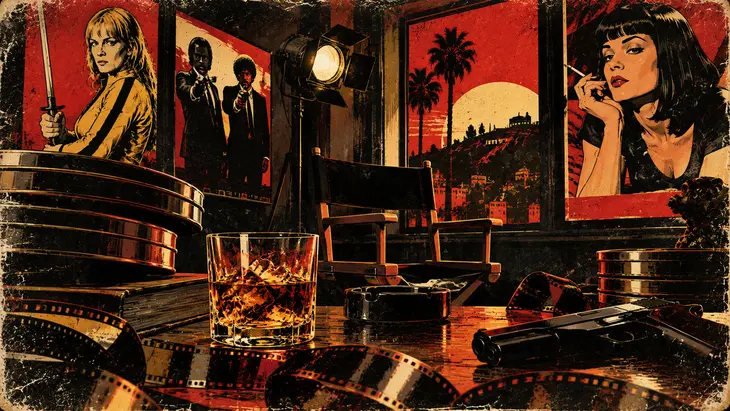
Quentin Tarantino’s filmography includes works in which he has different responsibilities. For some films, he is credited as both writer and director; in others, his writing reaches the screen through another director. Appearances in anthology works and projects discussed publicly need to be identified separately. Grouping them under a single name without specifying those credits makes it hard to understand what he did in each case.
The films he directed offer a journey from contemporary crime to stories set in other periods. The early films focus much of their action on negotiations and encounters between criminals. Later, combat, genre recreations and fantasies of revenge take on greater importance. This evolution retains earlier techniques: a period film can also build tension around a table and a conversation.
Release order makes it easier to observe these changes, although the stories need not be watched as episodes in a single saga. Kill Bill calls for special consideration: its two volumes tell one story. Distinguishing between a work, a volume, a version and a collaboration makes it possible to explore the catalogue with a clear approach, without revealing the endings each film has in store for the viewer.
A film’s release year identifies a stage in a career; its setting belongs to a different calendar. Following the releases makes it possible to see how Tarantino shifts between genres, scales and protagonists without imposing a single chronological continuity on his fiction.
The crime stories of the 1990s
According to the festival archive, Reservoir Dogs was presented at Sundance in 1992. It centres the conflict on the aftermath of a robbery. The group must decide whom to trust with incomplete information. The Reservoir Dogs guide places this standoff within a film that makes its characters’ stories part of the action: describing what happened can be as decisive as showing it. Its economical use of locations helps reveal the power dynamics between the members of the gang.
Pulp Fiction (1994) expands this criminal world through stories that intersect and reappear from different perspectives. The Pulp Fiction guide helps place its episodes without reconstructing them in advance along a timeline. The viewer encounters meetings, conversations and shifts in tone whose significance depends on where they fall in the story. Cannes’ official awards record lists its 1994 Palme d’Or; this recognition is part of the film’s reception and does not dictate a single interpretation of its episodes.
In Jackie Brown (1997), the adaptation of Elmore Leonard’s Rum Punch shifts the focus to a woman trying to gain more control over her decisions amid competing pressures. Money still drives the conflict, but age, work and the possibility of starting a new life matter too. The Jackie Brown guide explores this more restrained tone. Comparing it with the two earlier films reveals changes in who takes centre stage and how much time is given to observing the characters.
Combat, pursuits and period stories
Kill Bill was released in two volumes, in 2003 and 2004. The first gives more room to combat and shifts in visual style; the second develops encounters and conversations that complete the revenge story. The Kill Bill guide treats them as parts of a single work. This approach explains why ten feature films released between Reservoir Dogs and Once Upon a Time in Hollywood can be counted, or nine works if both volumes are grouped under one title.
Death Proof (2007) was part of the Grindhouse double feature, alongside Robert Rodriguez’s Planet Terror. Its mix of menace and pursuit shows how danger changes the position of those inside the vehicles. The Death Proof guide retains that connection to its original release, which is essential to understanding its exploitation-film texture. In the film, extended conversations and physical movement both help shape the rhythm, though with different levels of intensity.
Inglourious Basterds (2009) and Django Unchained (2012) bring revenge into period fiction. The Inglourious Basterds guide introduces a story in which languages and assumed identities shape encounters. In the Django Unchained guide, the rescue of Broomhilda organises the action around the slavery depicted in the film. Both call for a distinction between the historical context and the freedom fiction has to invent characters and events.
The Hateful Eight (2015) uses the Western to set up a standoff fuelled by suspicion, explored in the The Hateful Eight guide. Once Upon a Time in Hollywood (2019) shifts the point of view to an actor, his stunt double and Sharon Tate. The Once Upon a Time in Hollywood guide distinguishes that professional world from its imagined elements. The contrast between the two shows how a confined space and a journey through a city can sustain different forms of waiting and uncertainty.
Scripts directed by others and projects never released
True Romance was directed by Tony Scott from a screenplay by Tarantino, as confirmed by the edition of the text published by Grove Atlantic. From Dusk Till Dawn was directed by Robert Rodriguez, with a screenplay by Tarantino. The Quentin Tarantino’s screenplays and collaborations need to be identified by that specific responsibility: acknowledging his writing does not automatically transfer the film’s direction or all its visual decisions to him.
An idea expressed in an interview is not the same as a production. Tarantino’s unrealised projects need to be distinguished as proposals, developed screenplays or negotiations, using dated sources. This avoids adding hypothetical titles to the released films or presenting an old statement as a current announcement. A filmography documents works; the history of each project records processes whose outcomes may differ from what was first proposed.
Before comparing two editions of a film, it’s worth checking which version each one contains. The runtime alone does not prove that scenes are missing: credits, a special presentation or technical differences in playback may account for it. A marketing label such as ‘definitive edition’ does not explain what material has been added either. A useful comparison identifies the cut and describes the specific variations that affect the viewing experience.
For a first viewing, the original sequence order preserves information as the film reveals it. Reconstructing events chronologically may be interesting afterwards, once you know the film’s narrative choices, but it gives away information that may have been intended to appear later. A published screenplay offers another perspective: it is a writing document and may contain solutions that differ from those in the released cut.
Brief synopses help you choose a film based on its premise. Analyses of endings serve a later purpose and are best left until after you’ve seen the film, especially when revelations change how earlier scenes are interpreted.