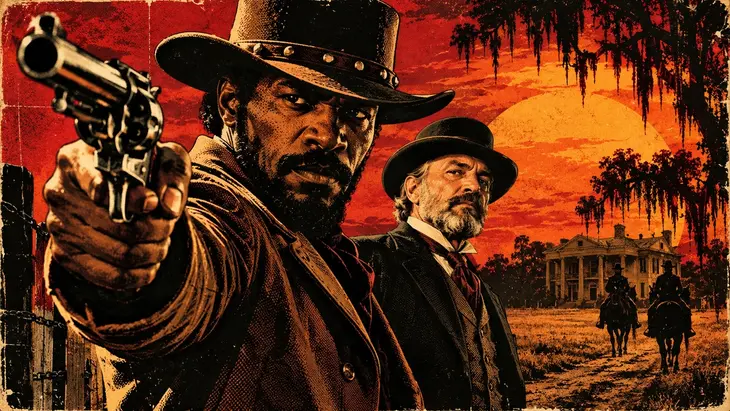
Django Unchained turns the search for an enslaved woman into the driving force of a rescue adventure. Django needs to regain his freedom, learn to navigate a hostile world and reach Broomhilda, his wife. Meeting bounty hunter King Schultz opens up possibilities that had previously been denied to him, although their interests and understanding of violence do not always align. Their relationship gives the film a blend of learning, negotiation and risk.
The journey crosses places where slavery determines who can move about, speak or have control over their own body. Tarantino shapes this world through the conventions of the Western and a deliberately exaggerated imagination. The weapons, costumes and music all help create a hero seeking to act for himself. When the action reaches Candyland, the estate of Calvin Candie, danger demands that characters be performed and intentions concealed. The adventure then becomes a test of patience: to get closer to Broomhilda, Django must endure a system of power whose brutality directly affects what he wants to regain.
Written and directed by Quentin Tarantino, Django Unchained was released in 2012. Its story brings together Django and Schultz’s partnership and the attempt to rescue Broomhilda. Sony presents the film through this personal goal: travelling across the territory and working as a bounty hunter take on meaning because they must bring Django closer to his wife.
Django and Schultz: a partnership with different goals
Jamie Foxx plays Django Freeman. The character moves from being subject to other people’s decisions to having a say in what happens around him. That transformation calls for practical skills and the ability to read other people. Foxx combines quiet observation with moments of open assertion; Django learns when it is best to let his companion speak and when he needs to stand up for his own position.
Christoph Waltz plays Dr King Schultz, a German bounty hunter. His gift for words lets him present violent situations as administrative matters and negotiate with an air of calm. Django has an urgency that goes beyond this command of explanations: finding Broomhilda. Their cooperation works because each brings something the other needs, while their different experiences make their relationship with the world they travel through unequal.
The learning process combines marksmanship, observation and acting. Django must recognise a threat and understand what those watching him expect to see. The story follows a clear direction, driven by his search, though images of Broomhilda bring an intimate dimension to it. His absent wife continues to give emotional meaning to a journey that might otherwise seem dominated by transactions and confrontations.
Candyland and the risk of keeping up a deception
Kerry Washington plays Broomhilda, who is enslaved at Candyland, the estate of Calvin Candie, played by Leonardo DiCaprio. The plan to rescue Broomhilda requires getting close to the owner under a false commercial identity. The challenge is to convince him that the visitors share his interests. Django must adopt an appearance that lets him enter, but also forces him to witness situations he finds intolerable.
Stephen, played by Samuel L. Jackson, brings another kind of surveillance into the house. His attentiveness to the relationships between people makes any misplaced gesture dangerous. Candie’s authority rests on a hierarchy that the other characters know and manage. The suspense builds as an apparently controlled conversation might reveal a hidden intention or a familiarity best concealed.
The dinner at Candyland concentrates this pressure in a shared space. Politeness requires people to remain close to those capable of violence, and the pauses leave time for everyone to watch one another. The scene turns information into an advantage: it matters who thinks they are in control, what each person suspects and how long they can maintain their role. The dinner distils a problem that runs through the entire visit: pursuing the rescue while appearing to take part in the very business that prevents it.
A Southern Western between spectacle and history
In his interview with American Cinematographer, Tarantino described the project as a Southern Western with Italian roots. The distances, armed encounters and presentation of the hero make its connection with Tarantino’s film genres and tributes recognisable. Arriving at the mansion changes the possibilities of the space: its rooms and occupants restrict the freedom of movement that the open landscape seemed to offer.
Cinematographer Robert Richardson told the same magazine about working with costume and production design to test colours and textures under the lighting. Sharen Davis and the costumes in Django Unchained are part of this visual construction. Clothing makes a social position or adopted persona visible; viewers can recognise changes in Django even before he explains them in words.
The historical context calls for a different kind of evidence. The Library of Congress holds documents about slavery in the antebellum South. The film explores this setting through fictional characters and situations. Distinguishing cinematic violence from the historical brutality of slavery makes it possible to assess the film’s expressive choices without treating an invented confrontation as documentary evidence. Exaggeration can deliver an adventurous release, while the subjugation of people’s bodies underpins the moral conflict of the rescue.
The humour in Django Unchained exposes the gap between an image of authority and the ability to maintain it. A discussion among hooded men about what they can see turns an intimidating preparation into a clumsy, practical problem. The effect comes from hearing their ordinary complaints in a threatening situation. The comedy makes those trying to impose fear look ridiculous.
Schultz creates another kind of humour through verbal precision. His lengthy explanations can unsettle people who expect immediate obedience or an aggressive response. The length of the sentence and the listener’s reaction matter just as much as its content. Waltz lets apparent politeness coexist with an awareness that he is controlling a dangerous situation.
These moments alter the pace of the adventure and the viewer’s perspective, too. A figure who has just provoked laughter may still be capable of causing harm. The film makes use of this instability: it lets viewers recognise the absurdity of someone’s behaviour without assuming the threat has gone away.