Quentin Tarantino’s films bring together work that is experienced as a whole on screen, even though the responsibilities behind it differ. A performer changes the rhythm of a line; the editing determines how long a reaction lasts; cinematography shapes the light and framing. Production coordinates resources and processes, while the music may come from new compositions or previously recorded tracks.
The recurrence of certain names makes it possible to compare collaborations across several films. That continuity does not mean they all share the same crew or that each professional always makes the same contribution. The credits for a particular work are the starting point for identifying who worked on it. Interviews and production documents can then help clarify how certain decisions were made.
It is also important to distinguish the person from their character. Recognizing an actor in several films offers a way to compare their range, but does not prove that the fictional characters share an identity. Likewise, hearing a song in a film does not prove that its creator took part in the shoot. Separating performance, technical work, production and music helps us appreciate these collaborations without attributing every element of the result to the director.
Film collaboration combines continuity with changes in the crew. Each film has its own performance, organizational and technical needs. Identifying credited responsibilities connects the result with specific people and avoids treating an authorial signature as an explanation for all the work.
Performers and the construction of the cast
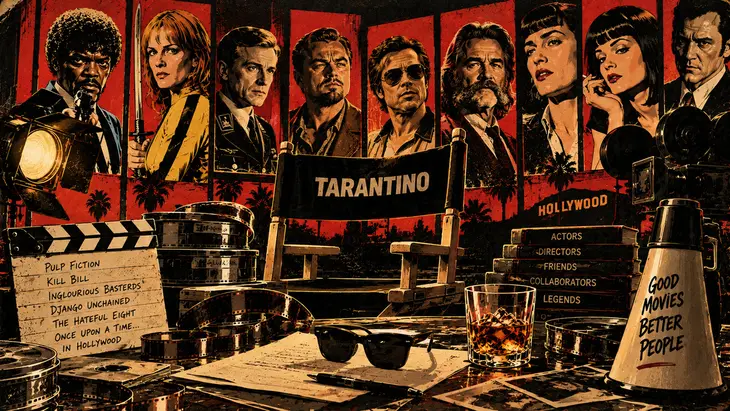
The Cannes record for Pulp Fiction lists John Travolta, Samuel L. Jackson, Uma Thurman, Harvey Keitel and Tim Roth among its performers. Several of them appear in other Tarantino films in different dramatic roles. Jackson appears in both crime stories and period films; Thurman moves from Pulp Fiction to the physically demanding lead role in Kill Bill. Tarantino’s recurring actors make it possible to compare that range without reducing each collaboration to a list of names or the repetition of a single character type.
Choosing a performer and working with them afterwards are related stages. Casting considers whether someone is right for a role; rehearsals and preparation develop their behaviour, relationships and physical requirements. Directing actors and preparing the cast explores these processes. Attributing a decision to the script, a direction on set or an actor’s suggestion requires identifiable testimony; a scene’s naturalness does not prove that it was improvised.
A performance is also experienced through the choice of takes and the responses that remain around it. The editing can hold on the gaze of the person listening before returning to the speaker. This relationship helps explain why a performance does not end with the line that is spoken: it belongs to an exchange of performances, camera positions and choices about duration that the viewer experiences as a single scene.
Editing, cinematography and production
For Pulp Fiction, Cannes credits Sally Menke as editor, Andrzej Sekuła as cinematographer and David Wasco as production designer. These are distinct roles within Tarantino’s technical crew: organizing the footage, creating the image and conceiving the settings involve related but not interchangeable decisions. Sight and Sound’s profile of Menke recalls her collaboration with Tarantino from Reservoir Dogs through Inglourious Basterds. That time span should be retained when discussing her work, without extending it to later films.
For Once Upon a Time in Hollywood, the British Council credits Fred Raskin as editor, Robert Richardson as cinematographer and Barbara Ling as production designer. The change in names is not simply explained as a change in style. Each film calls for a particular combination of locations, sets, lighting and filmed material. Comparing the roles makes it possible to recognize continuity in the crafts without assuming that one person created the entire aesthetic of the filmography.
Production and writing call for a different kind of precision. The Academy Awards’ 1995 record distinguishes between Tarantino’s screenplay for Pulp Fiction and the story by Tarantino and Roger Avary. For Once Upon a Time in Hollywood, the British Council credits David Heyman, Shannon McIntosh and Tarantino as producers. Tarantino’s creative partners and producers should be identified through their credits and documented work: writing a film, producing it and distributing it are distinct responsibilities.
Composition, songs and music supervision
The Academy of Motion Picture Arts and Sciences awarded Ennio Morricone the Oscar for Original Score for The Hateful Eight at the 2016 ceremony. This credit makes it possible to distinguish creating a score for a film from using previously existing music. Tarantino’s music collaborators work in different roles: composing, performing, overseeing the incorporation of recordings and adjusting their presence in the edit. Recognizing these tasks avoids confusing the composer of a piece with the person responsible for the entire soundtrack.
The Academy identifies Mary Ramos as music supervisor for The Hateful Eight in its documentation for the 2018 Careers in Film professional event. Her role is not the same as Morricone’s. Music supervision involves selecting and managing musical material; composition creates music. Editing and mixing decisions also bring the pieces together with dialogue, effects and silence. The final listening experience brings together processes that the credits allow us to distinguish.
Department titles can vary between original credits and translations. “Production design,” “art direction” and “set decoration” describe related responsibilities, but they are not interchangeable terms on every crew. When comparing two filmographies, it is best to retain the credited title and avoid turning a related role into one with a broader scope. The same applies to the different forms of production.
An acknowledgement, dedication or mention of a work among the references is also not the same as a credited professional contribution. These can document a relationship, support or affinity, but they need context before being included in the history of a collaboration. A person’s absence from a film, for its part, does not prove a conflict or allow us to attribute a cause.
Interviews provide additional information when they identify a film and a decision. Even so, remembering who suggested an idea does not always make it possible to reconstruct the entire process. It is preferable to describe the confirmed contribution and leave open any questions that the sources do not resolve.