
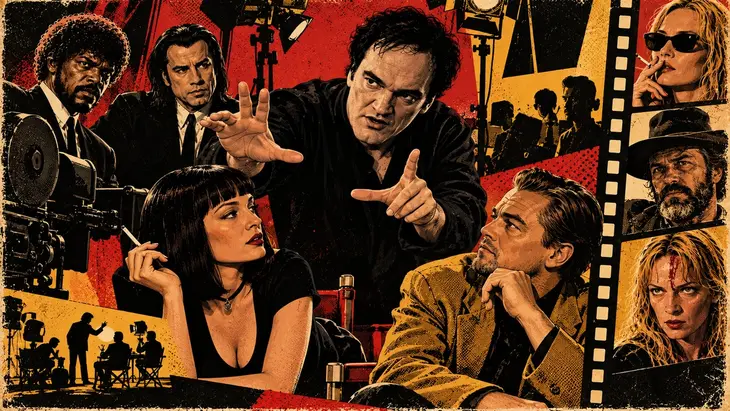
Tarantino’s direction of actors links casting choices with the specific demands of each character. A voice can establish authority before a threat is understood; a pause can reveal that someone is deciding how much to reveal. For those effects to be legible, the performance needs to pay attention to the words, the body and the response of the other actors. The personality of a star brings expectations that the new role may confirm or alter.
Casting tests and rehearsals make it possible to explore what happens when the text meets a voice and a body. A read-through may reveal that a fellow performer’s response changes the intention of a line. A shift in position may require a different rhythm or a different distance. The character thus acquires possibilities that need to be tested in relation to the people and objects in the scene.
The result depends on collaboration: whoever listens, moves or waits outside the centre of attention is still part of the scene. Preparation exists so that those actions can coexist with scripted dialogue and with the conditions of filming.
Work with a cast begins when deciding who can give shape to a character, and continues through tests, rehearsals and takes. The experiences described by performers make it possible to understand decisions in that process. A shared read-through, a movement adjustment or a casting choice all address different problems in performance.
Choosing a presence for the character
In a January 1998 conversation recorded by the BFI, Tarantino explained that he wanted Jackie to be in her mid-forties and that he was thinking of Pam Grier while preparing the writing. The choice of Grier for Jackie Brown linked the actress’s presence with a protagonist whose age was part of the conflict.
At the press conference for Death Proof in Cannes in 2007, Tarantino linked the writing of Zoë’s character with Zoë Bell herself. Writing a role with a performer in mind makes it possible to bring in recognisable abilities and ways of speaking. The character remains a dramatic construction: their goals, relationships and actions belong to fiction, even when they use features of the person playing them.
Familiarity with Tarantino’s recurring actors can also shape the reception of a role. A familiar voice or face means the viewer arrives with expectations. Casting can use that memory and then ask for a different response: vulnerability where dominance was expected, restraint where a verbal display was anticipated. The new performance still needs to hold within the specific situation.
Audition and rehearsal as shared work
Jennifer Jason Leigh told W Magazine in December 2015 that she had read the screenplay for The Hateful Eight without its final chapter, and received that material during the audition. According to her account, Tarantino sat beside her and read with her. The case shows an audition based on interpreting the text that included the response of an interlocutor: the actress could react to another voice while developing the scene.
In an interview with Observer in February 2016, Leigh explained that she and Kurt Russell had rehearsed for two or three weeks to learn how to move while linked by a chain. That rehearsal period for The Hateful Eight addressed a specific need. The distance between them affected their movements, the possibility of turning round and the timing of a reaction. One action could require an immediate adjustment from the other performer.
The chain makes visible a dependence that other scenes present in a less physical way. Standing up, moving towards a table or reaching for an object can alter another person’s position. Rehearsal makes it possible to discover those consequences and coordinate actions that must later seem like character responses. The precision gained leaves room to pay attention to the other performer while carrying out the movement.
The relationship between memorisation and improvisation requires a distinction between the written words and their delivery. Holding on to a line does not entirely determine its speed, volume or intention. A pause can express calculation, surprise or resistance depending on the situation. Verbal preparation makes it possible to work through those differences without turning the effort of remembering into the visible centre of the performance.
Performing also means listening and reacting
An ensemble scene divides attention between those who speak and those who receive their words. Silence can contain a decision, a suspicion or a change of allegiance. Tarantino’s direction of actors needs to make those relationships intelligible so that a conversation retains dramatic activity. A fellow performer’s response can transform the meaning of a line that, when read in isolation, seemed certain or persuasive.
The characters who pretend to be others add another difficulty: the performer constructs behaviour intended to deceive someone within the fiction. The viewer may know that purpose and notice signs that the other characters overlook. A hesitation or an excess of confidence then takes on two meanings, depending on who is watching. Performance manages how much of the effort of sustaining the adopted identity is allowed to show.
The physical work takes part in that same construction. Leigh described her coordination with Russell to W Magazine as a choreography. The interest of her testimony lies in the relationship between preparation and response: one person’s action conditioned the other’s. The tension the viewer perceives comes from how that exchange is organised. The intensity of the character and the concrete conditions of performance are aspects that need to be described separately.W Magazine their coordination with Russell as choreography. The interest of her testimony lies in the relationship between preparation and response: one person’s action conditioned the other’s. The tension perceived by the viewer comes from how that exchange is organised. The character’s intensity and the concrete conditions of execution are aspects that need to be described separately.
The performance that reaches the screen also depends on how the filmed material is selected and presented. A sustained shot allows us to observe the development of a reaction; a cut can make a glance seem to answer a line immediately. Acting offers expressive possibilities that editing organises within the scene.
When a conversation alternates faces, continuity between shots helps us perceive an uninterrupted encounter. The position of the hands, the direction of the gaze and the timing of a response maintain recognisable relationships between the participants. That continuity can bring different takes together: the final order presents selected material from the edit as a single exchange.
A response can begin while we are still seeing the person who has just spoken. That overlap allows a voice to change the meaning of the face that remains in shot. The scene thus preserves simultaneous actions, even though the frame shows only one person. The effect depends on the relationship between the performance, the sound and the choice of shot.