
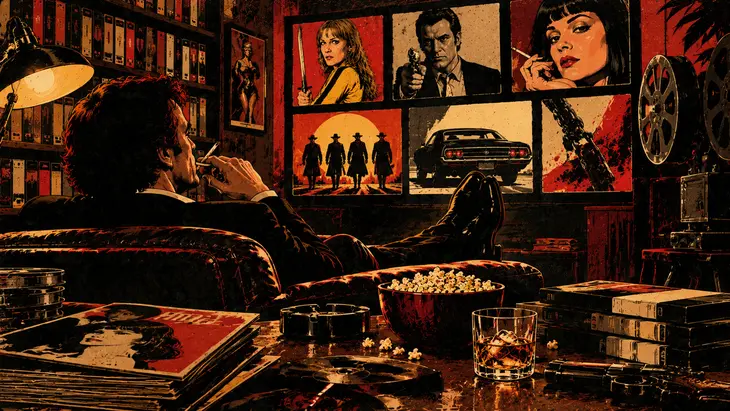
Quentin Tarantino's cinephilia has recognisable sources: signed texts, interviews, books, recorded conversations and exhibition activities. Those materials show how he comments on other people’s films and which aspects interest him as a viewer. They may contain praise, objections and personal memories, even when they deal with a work that is usually presented simply as one of his favourites.
A recommendation and an influence answer different questions. The first indicates that someone has valued or recommended a film in a specific context. The second proposes a relationship with another work and requires explaining what that relationship consists of. When that relationship comes from a statement by Tarantino it can be attributed to him; when it arises from a critical comparison it belongs to whoever formulates it.
His interventions are not a single, permanent ranking either. A selection for a poll depends on its rules; a comment in a podcast may focus on a print, a performer or a scene. Reading those differences carefully makes it possible to approach his tastes without erasing the nuances. Genre cinema, performances and the material conditions of watching films appear as connected matters, even though each allows its own conversation.
Talking about the films Tarantino appreciates requires keeping the context of his words intact. Enthusiasm for one sequence can coexist with reservations about the work as a whole. A mention, then, should be read before it becomes a recommendation.
Recommendations that can be attributed
The New Beverly review archive offers signed and dated examples. In the essay on Wang Yu published on 23 April 2020, Tarantino praises The Chinese Boxer and pays attention to the construction of its fight scenes. The assessment is expressed in the text itself; it does not depend on another author having found a similarity with Kill Bill. The films recommended by Tarantino gain precision when each selection preserves the source, the date and the type of comment supporting it.
The 2012 Sight and Sound directors' poll, whose BFI presentation includes Tarantino among its participants, is another kind of document. It responds to a call and shared rules. Its results should be distinguished from an annual selection of new releases or a conversation in which films from youth are recalled. The set of eligible titles and the question posed condition the meaning of the choice; mixing all those answers together creates a list that the filmmaker may never have actually formulated.
Tone matters too. A provocative comparison may question a film's reputation without sustaining a thesis about the director's entire career. A translation must preserve that scale. Expressions such as ‘the best’ need the framework that delimits the claim: it may concern a genre, a period or the works seen during a year. Removing that context turns a specific preference into a much broader statement.
Admired authors and film traditions
Admiration for a performer may centre on the physical energy of a role, on their voice or on the relationship they establish with their fellow actors. In a director, the comment may attend to framing, pace or a particular use of genre. The filmmakers and actors admired by Tarantino must be studied from those concrete observations. Praising one film does not imply approving an entire filmography, and questioning another does not erase the documented favourable comments.
The recommendations made by Tarantino by genre make it possible to place affinities without treating related categories as synonyms. Japanese samurai cinema and Hong Kong kung fu share the importance of combat, but they come from different traditions. A western may be interesting for its duels, its cast or the way it organises the landscape. The label helps locate a conversation; the arguments that accompany the title explain what the recommending viewer appreciates.
Comparisons with his own films require an additional step. To relate a scene to Tarantino's film style one has to describe the resemblance and clarify its source. There may be a statement about an influence or only an affinity proposed by the person analysing it. Both routes allow discussion, but their evidence is different. A visual resemblance does not automatically make the compared film a declared favourite of the director.
Written criticism, conversations and exhibition
The editorial presentation of Cinema Speculation, published in 2022, places the book between personal memory and criticism of 1970s American cinema. The Video Archives Podcast adopts a dialogic form: its official presentation identifies Tarantino and Roger Avary as hosts and Gala Avary as producer. These are two different practices among Tarantino's books, criticism and cinephile projects: the written argument can be revisited as an essay, while conversation allows us to hear agreements, disagreements and spontaneous associations.
Exhibition adds a material dimension. The New Beverly's official history describes its repertory programming and its commitment to photochemical prints under Tarantino. Showing two films together proposes a relationship and changes the experience of watching them, even if it does not establish a universal order of quality. This activity connects commentary with the cinema: it preserves the encounter between a work, a specific print and an audience, without the programming of a screening alone amounting to a ranking of favourites.
Genre films may circulate with several international titles, cuts and dubs. When identifying a recommendation, it is sensible to note the director and year, as well as the name used in the conversation. Two different titles may refer to the same film; an almost identical title may belong to a sequel or a new adaptation. This care avoids attributing praise to a work that Tarantino was not discussing.
The conditions of the encounter also help explain a memory. Watching a print in a cinema, discovering a home video or revisiting a film years later are different experiences. A retrospective assessment can explain a change of opinion without invalidating the previous one: each comment documents what its author expressed at that moment.
To make a personal selection from those references, it is useful to preserve the reason for interest: performance, cinematography, humour, suspense construction or mise-en-scène. That criterion makes it possible to choose what to watch according to one's own curiosity, without turning another viewer's taste into an obligation.