
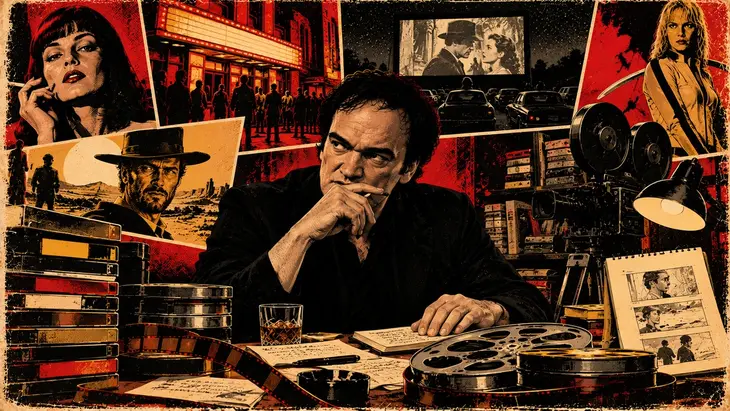
Quentin Tarantino carries out his film-critical work through writing, conversation and exhibition. Each form makes it possible to do something different with a film. An essay can connect the memory of a first viewing with a later judgement; a review focuses on the strengths and problems of a work; a conversation incorporates the questions or disagreements of other viewers. Scheduling a screening adds the possibility of sharing films on a particular screen and in a particular order.
The projects also have different participants and responsibilities. The byline on a text identifies its author. A podcast can bring together several speakers and have its own production. A cinema needs to choose films and have the prints and equipment needed to screen them. Recognising these differences helps us understand what Tarantino contributes in each activity and what work falls to other people.
The interest of this facet lies in the reasons he develops for valuing cinema: how he argues for a preference, what he makes visible when comparing films, and how he turns a personal hobby into an experience that others can read, listen to or share.
Written criticism and cinema programming begin from different decisions. One develops an argument about images and sounds; the other organises the conditions for encountering them again. In Tarantino’s projects, both activities coexist with the spoken exchange that characterises a podcast.
The essay and the review make it possible to pause over a film
Hachette dates the publication of Cinema Speculation to 1 November 2022 and describes its journey through American films of the 1970s that Tarantino saw in his youth. In the essay Cinema Speculation personal memory and film criticism overlap. That framework explains its selective character: the films form part of a viewer’s experience from which an interpretation of an era is built.
Memory and argument perform different functions in an essay like this. Recalling the impact of a film sets out the personal relationship with it; examining a scene makes it possible to discuss how that effect is achieved. The reader may be interested in the recollection and disagree with the judgement. Critical intervention becomes productive when it offers reasons that someone else can compare with what happens on screen.
Tarantino’s written reviews allow for a more focused scale. In his text on The Dynamite Brothers, published by the New Beverly on 1 April 2020, he expresses general reservations about Al Adamson’s cinema and, at the same time, defends that film. The assessment arises from that exception: the specific work forces a revision of a prior expectation about its director. It is an example of a nuanced judgement within an enthusiastically toned review.
Video Archives: films discussed between several voices
Gala Avary explained the format of The Video Archives Podcast in a public presentation on 14 December 2024. Quentin Tarantino and Roger Avary talk about films seen on the tapes of the former Video Archives; she takes part as producer and reporter, alongside producer Josh Richmond. In that presentation she also set out the move of the second season to Patreon, linked to greater independence in choosing films and to the relationship with listeners.
Starting from specific tapes gives the exchange a shared object. The participants can recall their impressions and discuss what they have just watched again. The conversation also preserves the difference between voices: an assertion by Avary or an observation by Gala does not become Tarantino’s opinion simply because it is part of the same programme. Disagreement can point to a scene or an interpretation that an individual contribution had overlooked.
In a podcast, the selection of films and the time devoted to discussing them help define the episode. That distinguishes it from a promotional interview, shaped by the questions and by the reason for appearing. Tarantino’s cinephile conversations and interviews can extend an explanation when someone asks him to clarify a comparison, recall a sequence or specify why an interpretation seems convincing to him.
New Beverly and Vista: exhibition as a cinephile activity
The official history of the New Beverly Cinema places the conversion of the cinema into a repertory house by Sherman Torgan in 1978. It also records Tarantino’s first programming in October 2014 with a double bill devoted to Paul Mazursky: Bob & Carol & Ted & Alice and Blume in Love. Pairing two titles invites a comparison that the audience can make during a single visit, while preserving each film’s identity.
The Vista Theatre extends his exhibition work. Discover Los Angeles, in information dated 21 August 2026, documents Tarantino’s purchase of the cinema in 2021 and its reopening in 2023. The cinema’s official website, consulted on 18 October 2026, announces screenings in 35mm or 70mm. These formats describe a presentation condition; the presence of a film on the bill does not in itself amount to a personal review by its owner.
The New Beverly’s history credits Tarantino with the decision to screen only photochemical prints. It is a concrete application of his defence of celluloid. The projection medium, the preservation of a print and the conditions of a screening are related, though different, matters. Choosing a film for a cinema expresses an exhibition preference; judging the result also requires attention to the image and sound the audience receives in that screening.
Appearing as a guest offers another way to share cinema. On 1 April 2020, the New Beverly announced an appearance by Tarantino on Pure Cinema Podcast, alongside Elric Kane, Brian Saur, Julie McLean and Phil Blankenship. The meeting was devoted to cinema, criticism and the series of reviews he had written for the cinema’s website. The episode made it possible to bring a previously written activity into conversation and open it up to the questions of other participants.
That move between media allows an argument to encounter new objections or connections. In a review, the author decides the full order of his exposition; in front of interlocutors, a question can stop him at a detail he had taken for granted. For the listener, learning appears in that development: an initial idea becomes more precise when explaining what an actor does, how a scene is structured or why a comparison with another film is relevant. The interest lies in following that explanation and weighing its reasons.