
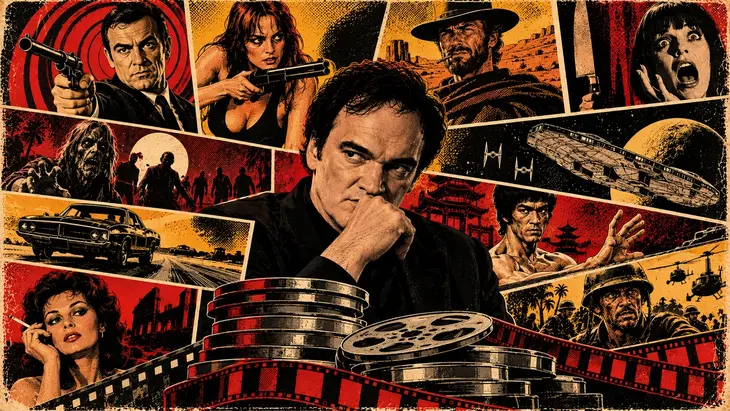
Quentin Tarantino’s genre film recommendations make it possible to approach very different films within the same interest. Two westerns may appeal for opposite reasons: one for the relationships between its characters, another for the wait before a confrontation. A martial arts film may stand out for the clarity of its fights, but also for its script. The label helps you find a family of films; the reason for the praise helps you choose within it.
Those families allow crossovers. Comedy can coexist with horror, and a crime adventure can include kung fu fights without losing its identity. It is worth recognising what each term refers to: a narrative setting, an industrial tradition, or a way of provoking emotions. This avoids conflating all Asian action cinema or reducing the western to its Italian variant.
The selections for a screening and the signed reviews offer concrete examples of these routes. Their interest lies in the films chosen and in the qualities Tarantino highlights as a viewer, before looking for connections with the works he has directed.
Searching by genre becomes more precise when you add a specific preference: landscapes and adventure, hand-to-hand combat, intrigue or macabre humour. A recommendation may answer to any of those interests. Sharing a label does not guarantee that two films will deliver the same experience.
Western: a tradition with different branches
The Cannes Film Festival announced on 14 May 2025 a Tarantino selection devoted to George Sherman: Red Canyon (1949) and Comanche Territory (1950). The festival presentation identifies his appreciation for the work Sherman developed at Universal during the 1940s and 1950s. These are two examples of his interest in the American western, a field that broadens the usual association between his cinephile taste and the Italian western.
The distinction matters when choosing films. The western is a broad family of stories about territories, communities and conflicts over authority. The term spaghetti western points to a European branch, especially associated with Italian production. Tarantino’s spaghetti western recommendations belong to that more limited field: not every western he praises automatically receives that label. Nor does nationality mean that every film treats violence or the hero in the same way.
A selection devoted to a filmmaker also makes it possible to compare decisions within his work. The way a town is presented, the characters are brought together or the landscape is used can become more striking when two nearby films are seen. That journey through the filmmakers admired by Tarantino answers to a different curiosity from simply looking for duels, chases or a certain type of protagonist: attention shifts towards who organises those elements and how they are combined.
Martial arts and blaxploitation: the value of crossovers
In his review of Fatal Needles vs Fatal Fists, published by the New Beverly on 9 March 2020, Tarantino praises the script, the camerawork and the performers, as well as the fights. The listing identifies a 1978 Taiwanese production directed by Lee Tso-nam. The example helps explain his martial arts and kung fu recommendations: a film may interest him for how it sustains a story between the fights, not only for the difficulty of a stunt.
On 1 April 2020, in another review written for the New Beverly, Tarantino presents The Dynamite Brothers (1974), by Al Adamson, as a crossover of kung fu and blaxploitation. Among his praises, he singles out Charles Earland’s music. That combination allows you to hear and observe two aspects of the spectacle: the drive of the physical action and the personality the soundtrack brings to the film.
Blaxploitation refers to a set of popular 1970s productions with Black leads and a recognisable cultural identity; it can include intrigue, action or horror. That is why the blaxploitation films recommended by Tarantino do not form a category equivalent to kung fu, defined by another kind of tradition and bodily spectacle. A film can belong to both fields without one cancelling the other out. The mix also makes it possible to see which element most excites a review.
Horror and comedy can share a screening
The New Beverly’s official programme for October 2016 identifies a horror-comedy marathon personally selected by Tarantino for the 29th. The titles included An American Werewolf in London (1981) and Beetlejuice (1988). The selection documents an interest in films that bring together the comic and the macabre, within a screening conceived around that coexistence.
Horror describes a relationship with fear, threat or the disturbing that can take very different forms. The slasher focuses on a variant of stalking and successive attacks; a supernatural story may be structured by other rules. When looking for horror films recommended by Tarantino, distinguishing these forms helps you refine your choice: sharing monsters, deaths or moments of suspense does not make all films part of the same subgenre.
Humour does not guarantee a comforting experience either. It can ease tension or make a situation even more uncomfortable. The romantic comedies and feel-good films recommended by Tarantino answer to another expectation, centred on relationships or on a sense of well-being. The presence of jokes, on its own, says little about a film’s final effect; what matters is how they coexist with danger and how much attention the characters receive.
In crime cinema, the label also changes depending on where the emphasis lies. A heist film is usually organised around a plan, the division of tasks and the unforeseen problems of carrying it out. Film noir may give greater weight to distrust, debts or the sense that every decision makes the situation worse. The same story can bring together both dimensions: the mechanics of the job and the deterioration of those involved in it.
The chase adds another possibility. If it dominates the story, movement, speed and the road setting can become its main attraction. If it appears in a single sequence, its presence is not enough to describe the whole film. To choose what to watch, it is useful to ask where the narrative spends most of its time and what one expects to enjoy: following an operation, sharing a character’s uncertainty or watching physical action. That precision makes a genre recommendation respond to a specific interest, even when the film combines several.