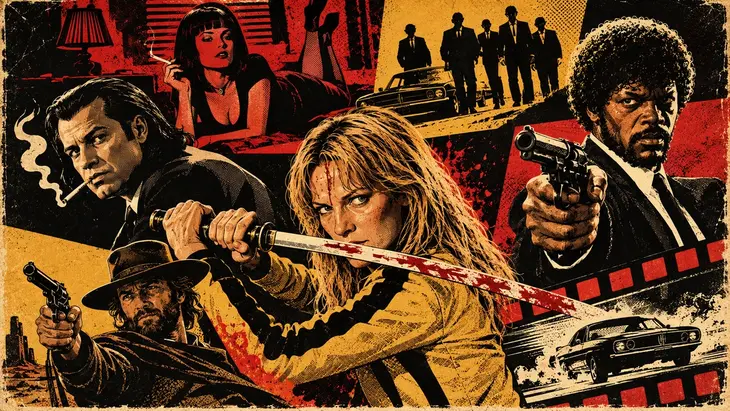
Quentin Tarantino’s cinematic homages draw on stories, images and expectations. A confrontation can take on the waiting game of a Western within a crime story; a chase can turn an everyday journey into a horror scene. A reference takes on a new function when the characters, setting and pace change. Recognising it adds a connection to another film, while the situation must still hold up through its own tensions.
Violence plays a part in these transformations. The same gesture can evoke fear, revulsion, surprise or a sense of release, depending on who experiences it, how long it lasts and what consequences remain. The films shift between registers and sometimes make those shifts uncomfortable. There are also different ways to talk about an influence: a filmmaker’s statement identifies a specific precedent; a resemblance between scenes allows us to draw a comparison. Both offer information, though they do not prove exactly the same thing. An analysis of the genres combines this evidence with an examination of how each work distributes sympathy, danger and agency among its characters.
Tarantino’s cinema transforms familiar conventions by changing the conditions in which they operate. A group of thieves can star in a film that leaves out the heist; a quest for revenge can shift from martial arts to waiting for a duel. Genre creates expectations about goals, risks and outcomes, while the narrative decides which ones to fulfil, defer or change.
Genres that change when they enter another story
Reservoir Dogs structures a heist thriller that does not show the heist as a complete sequence. The preparations and aftermath shift attention to what each participant knows about the others. The interest no longer depends primarily on watching a plan unfold; it centres on the difficulty of piecing together what happened and keeping an alliance intact after failure.
The Los Angeles crime film offers another frame of comparison between Pulp Fiction and Jackie Brown. Both connect money, jobs and negotiations, but the way their encounters are structured creates different experiences. The first shifts between protagonists and changes the order of events; the second sustains a relationship of trust as a financial operation moves forward. Sharing a setting and certain genre figures does not mean they have to share the same pace.
In Kill Bill, fights, training and duels bring together different action traditions. Its relationship with martial arts and sword-fighting cinema coexists with a reinterpretation of the spaghetti western. Waiting for an opponent, the distance between bodies and the chosen moment to act can carry as much weight as the sequence of moves. The blend shifts its emphasis between the two volumes.
Grindhouse and exploitation-film culture adds a connection with exhibition. Death Proof features signs of a worn-out print and alternates between conversation, stalking and action. The film’s look becomes part of the genre experience: its simulated imperfections evoke an object that seems to have circulated and accumulated a material history.
Visible borrowings and acknowledged influences
A similar composition can invite a comparison between scenes, but it does not automatically establish intent. Tarantino’s combination of references and pastiche brings together techniques that may come from different traditions and take on a shared function in a new scene. The connection becomes clearer when we describe what changes: the duration, the point of view, the role of the music or the position of the person who experiences the violence.
In a conversation with Scorsese published by the DGA in 2019, Tarantino explained his interest in the trailer for Pat Garrett & Billy the Kid: it alternated between action at normal speed and slow-motion impacts. The cited technique is an editing decision.
In a January 1998 interview reproduced by the BFI, Quentin Tarantino denied that Jackie Brown was a blaxploitation film. A work can engage with a tradition through performers, music or situations without adopting all its conventions. Its connection with the filmmakers and actors Tarantino admires provides context, while the classification of each film depends on how it structures the whole. A recognisable homage and belonging to a genre answer different questions about the same image.
Violence, distance and consequences
Cathartic violence and violence with a realistic effect describe responses that a film’s staging can encourage. The fights in Kill Bill turn movement and exaggeration into spectacle; the sustained pain of an injured man in Reservoir Dogs keeps bodily vulnerability in view. These are comparisons of effect, not categories that guarantee the same reaction in every viewer.
Duration changes our relationship with an act of aggression. A brief impact can come as a shock and give way to another action; staying with its consequences means watching what the affected person loses or needs. The framing can show the harm or direct attention to the person who hears about it. Graphic intensity is one part of this experience, alongside sound, anticipation and the viewer’s prior connection with the characters.
Revenge creates an expectation of redress, but its depiction still involves choices about whom we follow and whose suffering is emphasised. A film can encourage identification with someone seeking punishment while also showing actions that are difficult to accept. Humour does not necessarily remove that discomfort; it can prolong it by placing a disproportionate reaction alongside an everyday detail.
Borrowing a technique takes on a different meaning depending on this moral and narrative perspective. Slow motion can magnify a feat, make the effort visible or draw attention to the cost of a blow. The technique plays a part in the relationship between images and characters; its meaning depends on the situation the film has established before using it.
Situations of mutual threat show how a violent scene can depend on stillness. Several people retain the ability to act, but any decision immediately affects the others. The tension comes from this interdependence: waiting is also an action with consequences, even when no decisive move has yet been made.
The framing distributes the characters’ gazes and lets us see who is paying attention to whom. The editing can keep the group together or isolate a reaction, allowing the viewer to assess loyalties and hesitation. Conversation fills this interval and reveals the difference between certainty, suspicion and a promise of trust.
This kind of confrontation turns force into a problem of relationships. A character’s position depends on what another believes about them and on the obligations they have taken on before. That is why the outcome of a dispute can make sense in light of earlier decisions that seemed emotional or personal. The physical danger makes immediate a tension the narrative has been building for some time.