
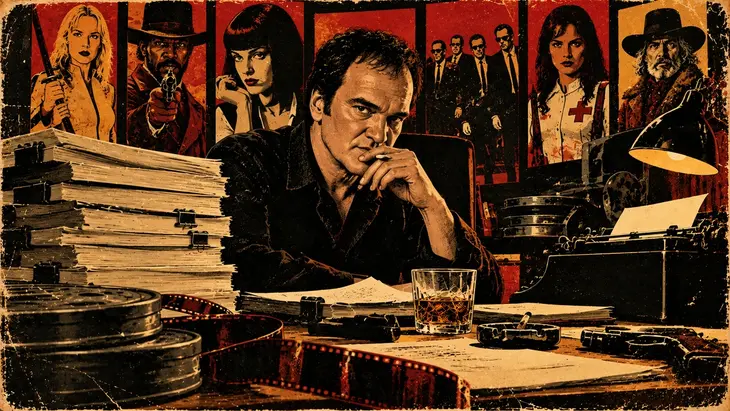
Quentin Tarantino’s screenplays have also led to films directed by other filmmakers. In those works, his characters and situations go through staging that responds to other people’s or shared decisions. This relationship makes it possible to observe how a story can take on a specific pace, visual style, and tone when someone else organizes its production. The writer’s presence remains within a work whose authorship includes other contributions.
The credits describe different situations. True Romance starts from a screenplay of his, while Natural Born Killers credits him with the story and gives the final screenplay credit to other writers. From Dusk till Dawn combines an original idea by Robert Kurtzman, Tarantino’s writing, and direction by Robert Rodriguez. Four Rooms and Sin City include limited contributions within shared films. This path shows work that includes developing original material, working from someone else’s proposal, and directing part of an ensemble. Each case relates writing differently to the work that ultimately appears on screen.
Quentin Tarantino’s involvement in a film can begin with the story, extend to a full screenplay, or focus on part of the shoot. These differences affect the relationship between his decisions and the result. The dialogue he writes needs performers, spaces, and a runtime; when another filmmaker directs, those elements are organized through a collaboration that can preserve, shift, or transform the text’s emphasis.
True Romance and Natural Born Killers: two screenplay paths
The Rotterdam Festival entry credits Tarantino as the screenwriter of True Romance and lists Tony Scott as director. Clarence and Alabama sustain a romantic relationship within a crime story. The True Romance screenplay and its adaptation thus bring together two movements: a couple’s desire to build a shared life and the pressure of an environment shaped by forces they cannot control.
The intimacy of the protagonists and the scale of the cast allow the story to change size. A conversation between two people can take on importance against a network of pursuers, intermediaries, and impulsive decisions. The finished film brings together romantic impulse and threat through acting, music, and editing. Recognizing Tarantino as the writer makes it possible to locate the textual origin without automatically assigning him all those production choices.
In Natural Born Killers, the American Film Institute catalog credits Oliver Stone with direction, Tarantino with the story, and David Veloz, Richard Rutowski, and Stone with the screenplay. This division is precise: the source material and the film’s credited writing occupy different places. The relationship between Tarantino’s screenplay and Oliver Stone’s changes in Natural Born Killers includes a transformation of the work during its development.
The contrast between criminality, public exposure, and media spectacle takes on a distinct audiovisual form in Stone’s film. The initial writing is part of its production history, but it does not make the released version a Tarantino-directed film. The example shows how a project can preserve a recognized contribution while changing creative leadership and treatment.
From Dusk till Dawn: an outside idea and a shift in genre
In a SYFY Wire interview published on February 4, 2026, Robert Kurtzman explained the origin of From Dusk till Dawn: his story and treatment gave way to Tarantino’s screenplay and Robert Rodriguez’s direction. The film was released in 1996. The process places Tarantino in a role different from that of the author who provides the starting point on his own.
The From Dusk till Dawn screenplay and its genre shift connect the Gecko brothers’ escape with a horror siege. The shift changes which abilities matter and how the characters relate to one another. Those who could threaten each other within a crime conflict must respond to a situation that alters the conditions for survival.
The writing has to prepare enough traits and tensions for the change to keep interest in the same people. The enclosed setting intensifies that continuity: earlier disagreements do not disappear when a different danger appears. The collaboration with Rodriguez thus combines character development and physical spectacle, two dimensions that must be coordinated to sustain the change in tone.
Four Rooms and Sin City: directing part of a shared work
The AFI identifies four segments in Four Rooms, from 1995, and credits Tarantino as writer and director of The Man from Hollywood. Allison Anders, Alexandre Rockwell, and Robert Rodriguez are responsible for the other episodes. Tarantino’s episode in Four Rooms centers the conflict on a wager and on the conditions the participants accept.
The situation allows an apparently simple explanation to become a negotiation of time, money, and authority. The short format requires establishing quickly who wants what, while the development depends on prolonging the wait. That relationship between conversation and action connects with Tarantino’s dialogue and narrative structure, applied here to a limited piece within a collective feature film.
In Sin City, from 2005, Cannes identifies Robert Rodriguez and Frank Miller as the principal directors. Miramax’s distributor presentation on Apple distinguishes Tarantino’s participation as a guest director. His guest direction in Sin City is part of a work with its own visual design and overall creative leads. The credit describes a specific intervention, on a different scale from writing and directing an entire episode in Four Rooms.
On September 21, 2026, Netflix announced The Further Mis-Adventures of Cliff Booth, directed by David Fincher from a new Tarantino screenplay, with Brad Pitt back as Cliff. The distributor announced IMAX screenings starting November 25 and a Netflix release on December 23, 2026. As of October 18 of that year, both dates were still in the future.
The collaboration adds a particular combination: a character from a film directed by Tarantino returns in a text of his made by another director. The continuity of the character can coexist with different choices of framing, length, and scene organization. Recognition of Cliff and Fincher’s involvement belong to different aspects of the same production.
This case extends Tarantino’s activity as a screenwriter within a career that is not limited to directing his own texts. Writing can maintain a relationship with an earlier creation and, at the same time, open a working space for another filmmaker.