
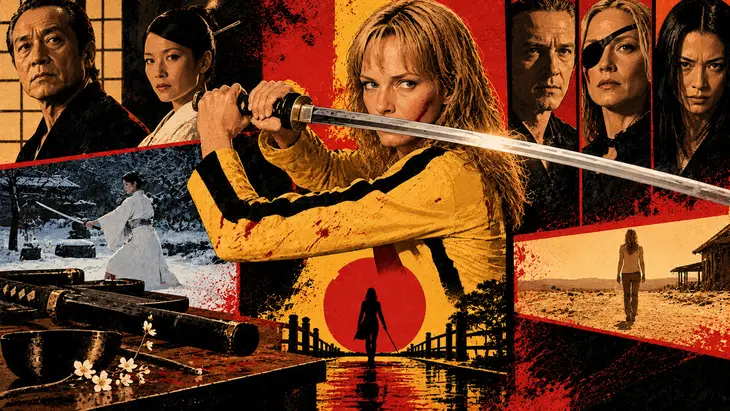
Kill Bill follows a woman who survives an attack by her former comrades and sets out on a quest for revenge. Her journey combines the precision of a hit list with the return of memories that alter our understanding of her relationships. Each encounter forces us to weigh abilities, debts and different ways of exercising power. The protagonist’s identity is built as much in the fights as in what she chooses to tell about her past.
The two volumes distribute that story at different paces. The first offers fast movement, striking visuals and major action sequences; the second allows more room for conversation, learning and waiting. Their unity comes from the same quest and from the questions it leaves open. The variety of genres gives each stage an expressive form: one duel may take on the concentration of a western, while another confrontation is driven by the speed and choreography of martial arts cinema. The spectacle always retains a relationship with physical endurance and the Bride’s choices.
Kill Bill presents a revenge story split into two volumes. The Bride survives the attack carried out during her wedding rehearsal and wakes up after four years in a coma. From that moment, she hunts down the members of her former group and the man who led it. The premise sets out a clear objective, while flashbacks delay the full explanation of her ties.
The Bride and a past that returns in chapters
Uma Thurman plays the protagonist, also known as Beatrix Kiddo. The film presents her as a body that must recover its abilities and as a person whose reputation precedes her. That combination organises much of the suspense: some opponents know her training, but no one can fully control how she will respond to an unexpected situation.
The Deadly Viper Assassination Squad links the opponents through a shared history. Bill occupies a different position from the others because his authority is both professional and personal. The Cannes credits for the second volume identify David Carradine as Bill, Michael Madsen as Budd and Daryl Hannah as Elle Driver. Their ways of speaking and waiting create different threats, even before any physical confrontation takes place.
The chronology of Kill Bill does not match the order of the chapters. The story may present an action and then return to the experience that explains a skill or a relationship. These shifts distribute knowledge between viewers and allow a scene of learning to have consequences much later on. The past thus remains actively present throughout the revenge.
Two rhythms for one quest
The first volume, released in 2003, moves between strongly marked visual registers. The second, presented at Cannes in 2004, expands the conversations and the moments of waiting. The differences in tone, style and genre between the two volumes affect the experience of time: a succession of adversaries can drive the action forward, while a visit or an oral account forces us to remain with an unresolved relationship.
The division does not amount to two separate quests. Information withheld in one part can change the meaning of the other, and the desire to reach Bill runs through the whole work. The ending of Kill Bill Vol. 2 brings together decisions and conflicts whose significance depends on that journey. Additional information can turn a physical feat into part of an emotional conflict. Knowing a promise or a memory changes the standpoint from which the next encounter is viewed.
The spaghetti western influences in Kill Bill Vol. 2 are evident in the attention paid to faces, the preparation for the encounter and the distance that separates opponents. Waiting can carry as much tension as a fight. Words make it possible to delay a blow, impose an interpretation of the past or discover how much the other person knows.
Fights, image and learning
The battle in the House of Blue Leaves turns the space into an active element in the fight. Entrances, levels and the number of opponents alter what the protagonist can do. The interest lies in recognising each difficulty and observing a readable bodily response, even when the scene changes scale or exaggerates its effects.
Production I.G identifies its involvement in the animated segment of the first volume. That shift in medium presents O-Ren Ishii’s past through another register of violence and imagery. The influences of chanbara and samurai cinema in Kill Bill Vol. 1 coexist with that animation, kung-fu cinema and situations drawn from other traditions. The combination assigns different forms to memories, challenges and rituals.
The training of Beatrix with Pai Mei shows that a skill requires repetition, pain and adaptation. The staging needs to make that process perceptible so that its later consequences carry weight. The direction of actors and the preparation of the cast connect performance and action here: physical effort must express stubbornness, frustration and learning, as well as carrying out movements.
Music takes part in these shifts of energy and anticipation. Cannes credits RZA and Robert Rodriguez in the music section for the second volume; RZA’s work on Kill Bill occupies a specific part of that sonic construction. Image, movement and sound sustain a heroine who moves through different genre codes without losing the continuity of her objective.
The humour of Kill Bill often appears when a fearsome figure takes part in an everyday activity. Attention to a meal, a job or a physical discomfort can interrupt the solemnity of revenge. That momentary descent into the practical allows the characters to be seen beyond the reputation that precedes them.
The visit to Hattori Hanzo uses the contrast between the atmosphere of a food establishment and the gravity of the task the Bride carries with her. Manners, bargaining and shifts in tone are part of the encounter before the weapon acquires its ceremonial dimension. The object needs a relationship between people in order to take its place in the story.
This coexistence of the domestic and the extraordinary also makes the rules of each scene variable. A gesture can be courteous and threatening at the same time; a trivial complaint can reveal resentment. The story uses these mismatches to avoid making all the opponents seem solemnly alike and to renew uncertainty at every encounter.