
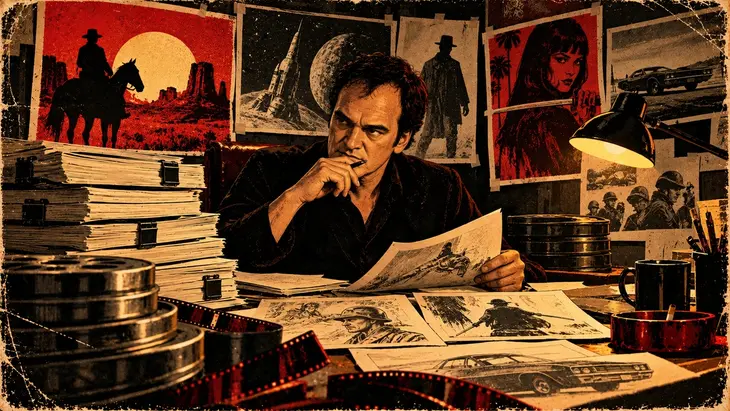
Quentin Tarantino's unmade projects bring together different situations: an idea discussed in an interview, a story developed by another screenwriter, a sequel considered for years, or a film the filmmaker chose not to direct. Interest in a character or a genre can produce work and discussion without ever becoming a shoot. Each proposal has its own path, with shifts in intent and different degrees of development.
Double V Vega, Kill Bill Vol. 3, Star Trek and The Movie Critic allow those differences to be recognised through dated statements and reports. An author's words describe what they thought or were doing at that moment; a production announcement identifies a separate commitment. The gap between the two explains why a title can keep circulating long after the priorities of the person who mentioned it have changed. It also matters who was meant to write and who was meant to direct: an idea from Tarantino can be developed by someone else, and a script of his can reach the screen under a different director.
The news about films Tarantino never completed forms a timeline of possibilities and decisions. Some begin with characters already known; others propose entering a franchise or developing a new story. The information available up to 18 October 2026 makes it possible to distinguish concrete precedents, although it does not turn every statement from the past into a permanent description of the future.
Double V Vega and Kill Bill: returning to familiar characters
SlashFilm published Tarantino's statements on 7 April 2007 from the show Opie and Anthony about Double V Vega. The filmmaker had considered a story in Amsterdam with Vincent Vega and a visit from Vic, Mr Blonde from Reservoir Dogs. In that conversation he regarded it as unlikely to go ahead and mentioned the actors' ages as a difficulty.
The account describes a proposed meeting between two characters, with a title and a starting point. It does not establish that it was filmed or that there was a finished script. Its appeal comes from bringing together figures the audience knows separately: expectations about both arise from earlier films, while the proposed relationship would need its own conflict to sustain a new work.
In the case of Kill Bill Vol. 3, Deadline published Tarantino's statements on 3 July 2023 in which he denied that he was working on that sequel. The denial applies to that moment. The two released volumes and a hypothetical third instalment are separate projects; bringing the earlier ones together in another edit does not in itself make a new part of the story.
A sequel also raises a different relationship with the time that has passed. It can pick up characters from the consequences of what they have lived through, but it needs new decisions about their situation and aims. The audience's familiarity provides emotional background; it does not determine which story will be written or prove that production is under way.
Star Trek: an idea developed by another screenwriter
UPI reported on 18 July 2019 on a Star Trek proposal that started from an idea by Tarantino and had a script developed by Mark L. Smith. Tarantino spoke of a possible direction in conditional terms. The Quentin Tarantino Star Trek project therefore reached a different stage of development from a simple mention of characters he would like to bring together.
The division of roles matters: supplying the idea is not the same as writing the script in full. Smith's work constitutes a writing contribution, while Tarantino's possible direction was another decision. The history of Quentin Tarantino's scripts and collaborations includes films made with different divisions of responsibility; in this case, the development mentioned does not allow us to say that a version directed by him was filmed.
Working with a franchise adds a framework of characters, settings and expectations that exists before the proposal. A new film has to find a situation capable of working within that framework or of changing it deliberately. The filmmaker's interest in a tone or genre does not by itself solve the decisions needed to turn writing into a production.
The Movie Critic: stepping away from directing a project
Deadline reported on 17 April 2024 that Tarantino had stepped away from The Movie Critic as a project he was to direct. The report documents a production decision at a specific moment. It does not establish that any written element could not be reused, nor does it automatically identify what his next feature as a director would be.
On 16 August 2025, Entertainment Weekly carried his comments on the podcast The Church of Tarantino: he had lost interest in directing The Movie Critic, although he enjoyed writing it. He also distinguished that story from the Cliff Booth project. The story and the statements about The Movie Critic therefore include a later explanation from the filmmaker himself about his decision.
The separation between writing and directing helps to understand that change without attributing motives he did not express. A text can satisfy its author and still not become the film to which he wants to devote a shoot. The career path in the film industry depends on those choices, as well as on contracts, collaborators and production conditions that are not always public.
Netflix's announcement on 21 September 2026 confirms the new script for The Further Mis-Adventures of Cliff Booth to Tarantino and the direction to David Fincher. These are details of an announced collaboration. Along with the distinction made by the filmmaker in 2025, they do not support presenting The Movie Critic as merely an earlier title for that film.
A script can reach the public before its film exists. The production notes for The Hateful Eight place its staged reading on 19 April 2014, at a benefit event for Film Independent. That project would eventually be filmed, but the reading already stood as an experience in its own right.
Hearing a text performed makes it possible to appreciate rhythms, interruptions and changes in authority between characters. Descriptions read aloud invite the audience to imagine spaces and actions that are not yet organised through framing and editing. The audience mentally completes part of what a film would solve with specific images and sounds.
For that reason, a public reading provides evidence of a text and a particular performance, without fixing all the decisions of a future production. An actor's voice can suggest a character without committing the final cast. This intermediate state deserves attention for what it makes possible to know: a provisional form of the work, whose dramatic force can be heard even though cinematic decisions still remain to be taken.