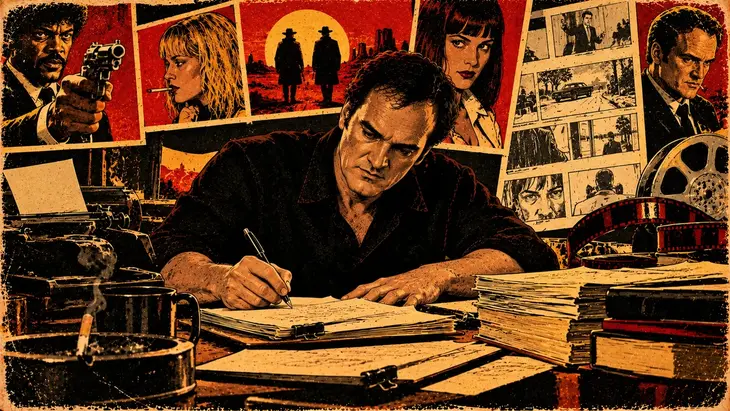
Quentin Tarantino’s dialogue makes conversation consequential. His characters compare tastes, share memories, ask questions and correct one another. As they talk, they try to seem interesting, gain permission, impose a version of events or find out how much their conversation partner knows. The subject of the chat may seem trivial, yet it can change the relationship between those involved. Personality emerges from what someone chooses to say and how insistently they try to make themselves heard.
The story arranges those words within a broader experience. A conversation changes when we learn some background, recognise a lie or see an earlier scene take on new significance. Chapters and shifts in time distribute that knowledge; actors turn it into breath, pace and pauses. Writing, structure and performance each contribute different choices to the result. Comparing them helps us appreciate why some scenes hold up for a long time, and why others need only a brief intervention. The length of a speech, by itself, explains little: what matters is what the speaker hopes to achieve and what options remain for the listener.
In Tarantino’s films, speaking is often a way of acting upon another person. Asking for an explanation, drawing out an anecdote or changing the subject can alter a situation even if no one moves from their seat. The script sets up these relationships; the story’s structure determines how much we know about them, and the performance shapes how we perceive them during the scene.
Conversation, digression and suspense
A narrative digression briefly diverts attention from the immediate goal. In Pulp Fiction, Vincent and Jules talk about eating habits while travelling on criminal business. Their chat reveals familiarity and differences in experience. An everyday observation can establish who likes to show off their knowledge and who demands precise details, before the pair adopt a different attitude towards others.
Dialogue-driven suspense arises when a threat remains unresolved while the conversation continues. The opening interrogation in Inglourious Basterds turns politeness into a form of pressure: each answer opens the possibility of a more compromising question. Unlike the conversation between colleagues in Pulp Fiction, what matters here is who gets to decide when the encounter ends. Its duration carries weight because walking away from the conversation comes at a cost.
The construction of a monologue concentrates the verbal initiative in one person for a time. Its effect depends on the reactions it provokes: persuading, disconcerting or intimidating calls for different listeners. A speech can change direction because of a look or an interruption. Attention to the listener prevents the scene from being reduced to a showcase for a memorable speech.
Timeline, chapters and returns
Tarantino’s non-linear narrative presents events in an order different from their chronological sequence. Reservoir Dogs intersperses background that changes how we see the group; Pulp Fiction rearranges entire episodes. The effect of each approach depends on the information it withholds or reveals in advance. A memory can clarify someone’s behaviour while creating a new uncertainty at the same time.
The chapters and prologues define sections of the story and shape expectations about what is to come. In his August 2009 interview with Terry Gross for Fresh Air, Tarantino explained the division of Inglourious Basterds into five chapters and the shifts in genre between its parts. A visible division can signal a change of characters, location or type of conflict without requiring each section to break with chronological order.
In a circular structure, returning to an initial situation lets us reconsider it in the light of what we have learnt along the way. Pulp Fiction uses the restaurant as a point of return, whose meaning depends on the stories in between. Structure can also work without headings: in his 2019 conversation with BAFTA, Tarantino recalled removing the chapter headings from Jackie Brown, while keeping an arrangement centred on different characters.
Writing and creating a voice
When explaining how he began writing, Tarantino recalled in his 2008 Cannes masterclass that he would reconstruct scenes from memory to perform them in class, filling in the passages he had forgotten. The anecdote describes a specific learning process. In a script, choosing a word also means imagining someone who needs to say it to another person, in particular circumstances.
On Fresh Air in 2009, he distinguished linguistic fluency from the ability to perform the rhythms, wordplay and jokes in his dialogue. Directing actors and preparing the cast works with that distinction. In his BAFTA conversation, he contrasted Ordell’s loquacity with Louis’s body language in Jackie Brown: characterisation allows for very different levels of verbal expression. An appearance of spontaneity may depend on a carefully measured performance.
Multilingualism in the script distributes understanding among characters who speak different languages. In Inglourious Basterds, switching languages can change who has access to information and who is left out. The audience, moreover, may have subtitles that let them understand more than one of the people present. This inequality creates suspense even when the words being spoken are formally polite.
A statement delivered with confidence takes its meaning from the relationship in which it is spoken. Jules, Ordell and Hans Landa each try to get different responses from the people in front of them. Their words express beliefs, strategies and moods that the film can put to the test. To interpret a speech, it is worth considering what the speaker achieves and how they treat the person listening.
Nor does an engaging voice guarantee a sound argument. Humour and verbal precision can make it enjoyable to listen to a character who is trying to intimidate or deceive. That combination makes the viewer’s response uncertain: enjoying a performance and recognising the violence of a character’s behaviour can happen at the same time.
The context changes when the story gives someone else room. A reaction that seemed secondary can reveal the real effect of a joke or an order. The conversation then takes on a dimension that goes beyond its most memorable lines: it includes the effort of responding, the option to refuse and the pressure of knowing that someone expects a particular answer.