
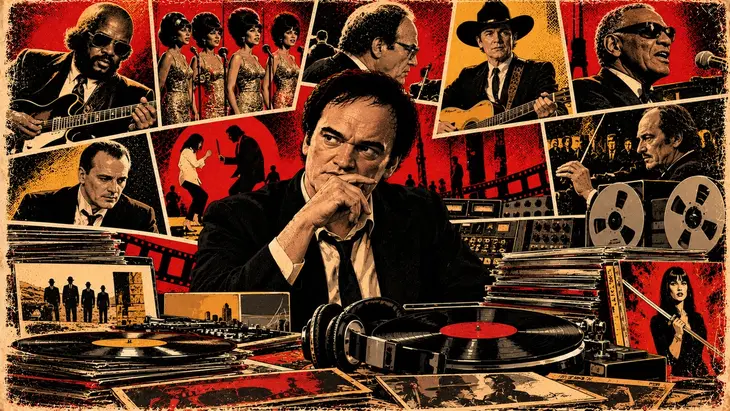
Quentin Tarantino’s musical collaborators contribute in different ways to his films. A score may be written for a new script; a pre-existing recording may take on another function when it is brought into a scene. Music supervision works to find and manage the material chosen. Identifying these contributions makes it possible to recognise both the composer and those who help turn a musical idea into part of the film.
Selection also does not end when a title has been decided. A song can have different interpretations, and each recording has a specific tempo, voice and instrumentation. Work on that version continues when it is tested alongside the actors or adjusted to the edited material. Hence the history of a soundtrack brings together artistic collaborations and preparatory tasks.
The testimonies of Karyn Rachtman, Mary Ramos and RZA offer examples of these processes. The relationship with Ennio Morricone also makes it possible to observe how the use of pre-existing music and the commissioning of a score coexist. The credits for each work specify the extent of each contribution.
The question of who makes the music for a film needs to focus on the specific piece. It is possible to bring together works by different composers, already recorded performances and material created for the shoot. Collaboration changes according to what the scene needs and what material exists to solve it.
Composing a score and working with pre-existing music
Tarantino explained in his January 2016 interview with Double J that he wanted an original theme for The Hateful Eight. In that context, he described the meeting with Ennio Morricone , who had received an Italian translation of the script. The commission began with a film that still needed to find its music. The composer could suggest a sonic identity born from reading the story, while the director considered how to integrate it into the work.
RZA had already contributed to the music of Kill Bill. In an Associated Press interview reproduced by the Wu-Tang Corp. website in April 2004, he spoke about the importance of matching the music to the movement of the action. RZA’s collaboration with Tarantino makes it possible to recognise the composition within a film that brings together materials from diverse sources. His contribution does not make all the songs or fragments heard alongside it his own compositions.
The Warner Music discography for Kill Bill Vol. 1 identifies, for example, Bernard Herrmann with Twisted Nerve, Nancy Sinatra with Bang Bang and RZA alongside Charles Bernstein on Crane / White Lightning. The names correspond to different pieces and contributions. The whole requires those credits to be preserved even when the edit makes all the materials seem to belong to the same world.
Fred Raskin recalled in Slant in January 2013 the inclusion in Django Unchained of Nicaragua, music by Jerry Goldsmith for Under Fire. He explained that they made small picture adjustments to fit it in. The reuse of scores, within the music of Tarantino’s films, can involve new work on the scene without changing the authorship of the composition. The meeting between film and piece is built during editing.
Karyn Rachtman and Mary Ramos: making the choice possible
Karyn Rachtman told Cuepoint in September 2014 that Tarantino had chosen Urge Overkill’s version of Girl, You'll Be a Woman Soon for Pulp Fiction and that her job was to finalise the agreement to use it. Karyn Rachtman’s account distinguishes the director’s preference from the supervisor’s intervention. It makes it possible to assign to each person their part in a decision that needed to become a real production possibility.
In July 2019, Mary Ramos explained to GQ that they prepared a track so Leonardo DiCaprio could rehearse Rick Dalton’s musical performance in Hullabaloo. The chosen song ended up being The Green Door. Mary Ramos’s work in music supervision thus included a need of the shoot: giving the performer material with which to prepare an action. The music had to work for the character singing before a camera within the fiction itself.
These examples show different needs within the same profession. A recording may have been selected from the script stage and require later negotiation. In another case, material must be prepared so that the actor can practise before filming. Supervision links those needs to the film’s schedule and maintains contact with those who have to work on the music.
Editing and record release add other jobs
Trying a piece against images makes it possible to judge where it enters, how long it lasts and what it allows to be heard around it. That work connects music supervision with the editing and sound team. The version used in an initial test may need later adjustments; the scene needs the music to form a specific relationship with the voices and the other sounds. An artistic choice thus passes through several hands before reaching the viewer.
Third Man Records announced on 18 December 2015 its vinyl edition of the soundtrack to The Hateful Eight. The label founded by Jack White presented a double LP with printed film material. Jack White and Third Man’s relationship to this edition relates to the record release. The label puts a recording into circulation and prepares its physical presentation; that work keeps Morricone’s composition distinct.
Orchestras are also part of these collaborations. The Czech National Symphony Orchestra documents its work on The Hateful Eight and a special session at Abbey Road in a statement of 18 December 2015. Morricone conducted the ensemble there in a recording of music from the film made directly for vinyl. Tarantino, Kurt Russell and Walton Goggins attended the event.
The session was presented as an activity linked to the release. That precision makes it possible to distinguish a performance recorded for a specific occasion from the full recording history of a soundtrack. Sharing composer and repertoire does not automatically turn two sessions into the same event.
The case brings musicians into a conversation that usually stops at the author of the score. They are the ones who play the notes and respond to the conductor’s instructions during the take. The result retains performance decisions as well as the musical writing: a work can be recognised in different versions and, at the same time, acquire its own nuances in each performance.