
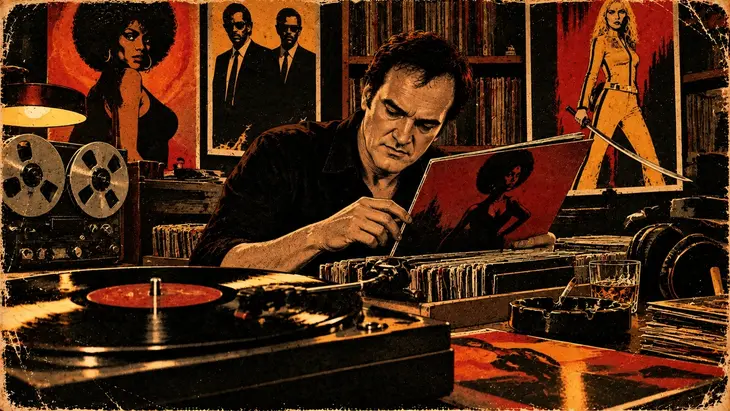
The music in Tarantino’s films can announce an entrance, accompany a conversation or change our relationship with a violent image. Its effect depends on the moment it appears, on who can hear it, and on what takes its place when it ends. Recognising the title of a song helps identify it, but understanding the scene also requires paying attention to its duration, its volume and its relationship with the voices.
Recordings made before filming sit alongside music composed for a film, radio broadcasts and sounds designed to give shape to a space. A familiar piece arrives with the viewer’s own memories; a barely perceptible noise can draw attention to a gesture that seemed secondary. The mix decides how these presences relate to one another and what can be distinguished between them.
This diversity prevents the soundtrack from being reduced to a collection of famous tracks. The experience also includes pauses, breaths, movements and changes in atmosphere. The interest lies in listening to how the scene directs our attention: what it lets us anticipate, what it keeps out of reach, and what it transforms when a sound returns in a different context.
The soundtrack brings together music, voices and effects in a single listening experience. Each element can take the foreground or pass almost unnoticed. In Tarantino’s cinema, the shift between these positions helps organise rhythm, closeness to a character and the perception of a threat.
Who listens to the music within the scene
The distinction between diegetic and non-diegetic music describes its relationship with the narrated world. A radio or a performance belongs to the characters’ space, even if the source is off screen. Other music accompanies the image for the viewer without being part of that space. These are narrative positions: neither depends on whether the piece is old, recent or composed specifically for the film.
The dance between Mia and Vincent in Pulp Fiction turns You Never Can Tell into part of a shared activity. The soundtrack edition released by Universal credits the recording to Chuck Berry. The music provides a rhythm to which bodies can move closer, imitate one another or keep their distance. The meaning of the scene depends on that relationship between people, as well as on recognition of the song.
The radio in Tarantino’s films allows songs, adverts and voices to come together in a continuous flow. In his interview with Kim Morgan published by the New Beverly in September 2019, the director explained that he used recordings of KHJ programmes to prepare Once Upon a Time in Hollywood. The broadcast offers everyday companionship and a way of travelling through the city from inside a car.
The entry and exit of a piece also carry meaning. Brief musical inserts can emphasise a gesture or mark a change of register without developing a whole song. A sudden cut forces us to hear what was lying beneath; extending the music over several images can join places that the edit keeps apart. The chosen duration belongs to the construction of the scene.
Selecting recordings, composing and coordinating their use
A pre-existing recording brings a specific performance, arrangement and sonic texture. Changing version can alter the perceived speed or energy of a passage, even if the melody remains recognisable. Musical selection is also a matter of adjusting those qualities to movement, shot length and the placement of voices. The effect comes from a precise combination, not simply from choosing the right title.
The Hateful Eight includes an original score by Ennio Morricone, awarded by the Academy of Hollywood in 2016. That case makes it possible to distinguish composing new music from using works that already existed. Tarantino’s musical collaborators are involved in different capacities: writing a score, performing a piece and overseeing its inclusion in a film require related work, with their own responsibilities.
In the same New Beverly conversation, Tarantino described Mary Ramos’s role in locating materials and contacting a composer for Once Upon a Time in Hollywood. The example shows a coordinating function that accompanies artistic choice. Identifying a melody does not by itself resolve which recording can be used or how it will be incorporated into the edit. Music supervision and editing help turn an intention into working material.
Ambience, details and the sense of silence
In a 2009 CineMontage interview, Wylie Stateman and Harry Cohen explained how the sound of Inglourious Basterds narrows attention during a conversation: the presence of the restaurant recedes while certain nearby details gain prominence. Ambient effects and foley take part in that selection. The sounds of an action can be recorded or recreated and then adjusted so that they stand out, blend in or make room for other information.
The sense of silence can be built without completely emptying the sound track. Removing the music leaves a breath, a room or a pause between replies exposed. It can also reduce the ambience while a small, close sound remains. That shift in proportions makes the viewer listen differently: an ordinary gesture begins to seem like a signal and a wait takes on an uncomfortable duration.
Sound design makes it possible to suggest a presence we cannot yet see. An engine, footsteps or a voice off screen expands the space beyond the frame. The mix regulates its closeness and its relationship to what is visible. Threat can be announced by sound while the image is still occupied with something else; when both pieces of information come together, the viewer has already begun to form an expectation.
Listening to a soundtrack album and listening to a film produce different experiences. The record allows a piece to be followed with continuous attention; the scene may interrupt it, layer conversations over it or use only part of it. A track that works as a transition for a few seconds may occupy a full track outside the edit. Its importance on the album does not necessarily measure its duration or weight within the story.
The relationship between sounds also changes. In isolated musical listening, the visible space, actions and much of the voices that guided attention disappear. A passage may seem relaxed in itself and become unsettling when it accompanies a dangerous situation. That shift explains why recognising a song is not enough to reconstruct the effect of the sequence.
To compare both experiences, it is useful to observe where the piece begins, what remains audible over it and when it is cut off. The comparison makes it possible to appreciate editing decisions that a song list does not record. The album preserves a musical selection; the film turns that selection into relationships between bodies, places, actions and times.