
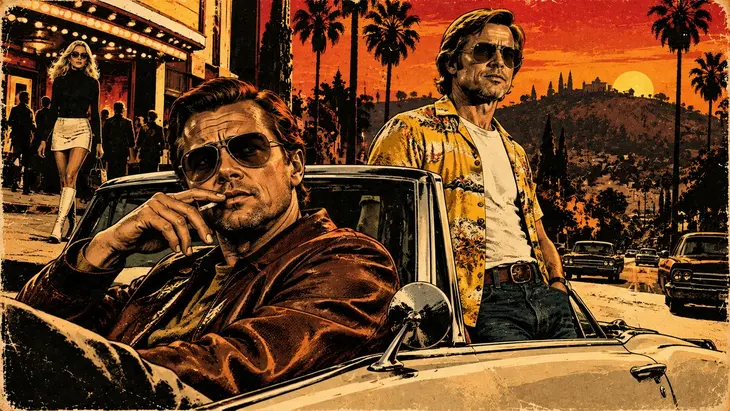
Once Upon a Time in Hollywood looks at the world of show business through the people trying to find a place in it. Rick Dalton fears his best chances may be behind him; Cliff Booth organises much of his life around working with Rick; Sharon Tate enjoys a career that is beginning to open up. Their days take in studios, roads, homes and cinemas. The glamour of a star coexists with tasks that no one applauds and the uncertainty of the next job.
The film devotes time to those routines because they reveal one way of belonging to Hollywood. Driving to a shoot, preparing a character or sitting among an audience can carry as much weight as a decisive conversation. The recreation of Los Angeles links the journeys through facades, sounds and familiar faces. Within that landscape, historical figures and invented characters share a narrative that uses the past as material for fiction. The emotional closeness to an era emerges from its everyday details, the images it produces and the aspirations it awakens in those who make their living from them.
Once Upon a Time in Hollywood, released in 2019, places its characters in Los Angeles in 1969. Rick Dalton, played by Leonardo DiCaprio, is a television actor worried about his career; Cliff Booth, brought to life by Brad Pitt, is his stunt double and friend. Sony's introduction places both of them before an industry that is changing. Sharon Tate, played by Margot Robbie, introduces another relationship with that same environment.
Rick, Cliff and Sharon: three ways of living from cinema
The problem for Rick Dalton is continuing to work while measuring every opportunity against the image he has of himself. A role may seem to him like a step down and, at the same time, demand considerable professional commitment. DiCaprio makes the need for approval coexist with moments of precise craft. The actor's insecurity and the effectiveness of his performance within a scene can feel very close together.
Cliff occupies a less visible position. His work depends on the body, on other people's trust and on assignments that go beyond stunt work. The friendship between Rick and Cliff combines everyday help and workplace inequality: one has a house and a public image; the other sustains part of that comfort. Their familiarity allows us to sense the affection without erasing the differences between their living conditions.
In the character of Sharon Tate, the pleasure of taking part in cinema takes on a more open expression. The sequence in which she enters a cinema and watches the audience's response to her work places an actress among spectators. Hearing laughter or recognising a reaction offers a form of recognition different from an interview or a promotional photograph.
History, invented characters and films within the film
Rick and Cliff are fictional characters; Sharon Tate was a real actress. Tarantino brings those presences together in an imagined plot, with encounters and situations that belong to his story. Identifying a historical name allows us to recognise a reference, but it does not turn every gesture or conversation in the portrayal into a biographical document. The film builds dramatic relationships between figures of different origins.
Rick's invented career adds another layer. The fragments of his productions mean that he can exist as a star even within the screens that appear in the story. When we see him act in a western, we attend both to the fiction he is performing and to the professional who needs to get a take across the line. The shift towards New Hollywood thus becomes a concrete concern with prestige, available roles and continued employment.
Robert Richardson explained to Kodak that principal photography used anamorphic 35 mm, while the television passages also used black and white; some domestic images were shot in 16 mm and Super 8. The differences in texture and framing help distinguish ways of producing and remembering images. The past appears through several media, each with a recognisable look.
A city that is travelled through, heard and narrated again
The Cannes credits list Barbara Ling for production design. The recreation of Hollywood Boulevard in 1969 forms part of a landscape where advertisements, shops and signs set out the characters' aspirations. The journeys give the city duration: the distances between a studio, a house and a venue affect the way a day unfolds.
The soundtrack of Once Upon a Time in Hollywood takes part in those journeys. The radio brings together songs, voices and adverts, so the cars also carry a shared experience of the era. At times, music accompanies an activity without interrupting it; at other moments, it dominates the rhythm of the editing and turns a succession of locations into an overall impression.
The novel Once Upon a Time in Hollywood, written by Tarantino and published in Spanish by Reservoir Books in June 2021, extends this world in another medium. The publisher presents it as an expansion that reorganises the film narrative. Prose can incorporate background and thoughts differently from a glance, a voice or an edit; that difference affects how we come to know its characters.
The film within the film allows us to observe two scales of judgement. Rick may assess his career by the size of a role, while those working alongside him need him to complete a specific scene. Learning the lines, hearing a cue and regaining concentration are small tasks beside the aspiration to be a star, but they determine what can ultimately be seen on screen.
This distance makes mistakes expressive. An interruption exposes the person who had been holding the character together; resuming the take requires rebuilding a confidence we have already seen fracture. The film values effort without guaranteeing that a good day will solve an entire career. Successful work can coexist with concern for the future.
It also changes the way we watch acting. We can recognise Leonardo DiCaprio, follow Rick Dalton and observe the character Rick is playing, all within the same sequence. The pleasure comes from perceiving how those levels hold together and slip out of alignment: a convincing fiction depends on a professional who is still struggling to convince himself.