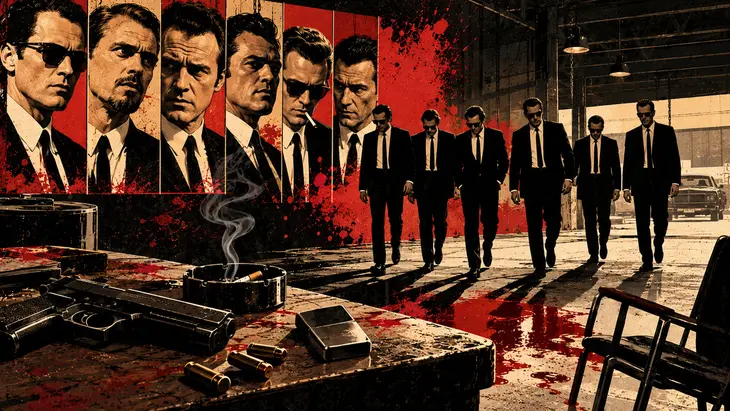
Reservoir Dogs puts the aftermath of a heist at the centre of a crime story. A group of men need to figure out why the plan failed, whom they can trust and what to do about the threat of betrayal. The money takes a back seat to more immediate concerns: an injured man, conflicting accounts and the difficulty of maintaining discipline. The film makes visible the cost of an operation its participants thought they could control.
Uncertainty stems as much from how the story is told as from what happens. Flashbacks interrupt the group’s meeting and change our understanding of its members. At the same time, the suits, aliases and ways of speaking create an air of professionalism that the men’s frightened or exhausted bodies put to the test. Humour can last only a few seconds before a conversation turns threatening. This blend of tones defines a film whose economical use of space lets us observe gestures, silences and power dynamics. Its violence has material consequences and changes the trust of those who witness it.
Reservoir Dogs begins with a botched heist and a question that threatens to destroy the group behind it: how did the police get there so quickly? The film avoids showing the heist as a complete action sequence. The viewer learns about its consequences and hears partial explanations, so uncertainty affects both the characters and how we interpret what happened.
A group brought together by a job and divided by suspicion
Joe Cabot organizes the operation with men who are to use colour names. The precaution is meant to limit personal knowledge and maintain control. However, the danger at close quarters brings out feelings, rivalries and loyalties that go beyond the rules. The colour names in Reservoir Dogs capture this contradiction: they create a shared identity for the job while concealing the backgrounds of the men doing it.
The cast of Reservoir Dogs is built on recognizable temperaments before we know all the details. Harvey Keitel plays Mr. White; Tim Roth, Mr. Orange; Steve Buscemi, Mr. Pink; and Michael Madsen, Mr. Blonde. Lawrence Tierney and Chris Penn play Joe and Eddie Cabot. Veteran authority, physical vulnerability, defensive calculation and menacing calm are not fixed traits: one intervention can shift each man’s position within the group.
Their matching clothes heighten the tension between belonging and individuality. The dark suit seems to promise a well-organized operation, but it soon shares the frame with blood, disorder and arguments. A professional appearance does not guarantee competent behaviour or a uniform response to fear. The film lets us tell the characters apart by their movements and by what they are trying to achieve when they speak, even when they all share the same outward appearance.
Time and space as sources of tension
The warehouse in Reservoir Dogs serves as a meeting place and somewhere to wait. People coming and going change how much information is available, while staying there forces the men to live with the effects of the heist. A large space can feel closed in when no one knows whether leaving means abandoning a partner, losing the money or confirming a suspicion. That pressure makes the distances between bodies part of the conflict.
Flashbacks reveal what came before at carefully chosen moments, reshaping an earlier impression. The chronology and narrative structure of Reservoir Dogs let us distinguish between the sequence of events and how they are presented. As we watch, this difference creates an unstable sense of what we know: behaviour that seemed straightforward takes on a new meaning after a conversation or a memory.
The accumulation of decisions matters as much as the identity of the person who is lying. Every attempt at self-protection can make things worse for someone else, and every show of trust involves a risk. The ending of Reservoir Dogs depends on how those loyalties collide. The uncertainty is tied to decisions the men make without being able to know their companions completely.
Production, music and shifts in tone
Sundance documents the project’s time in its directing lab in 1991 and its premiere at the festival in 1992. The AFI Catalog credits Lawrence Bender as producer, Andrzej Sekula as cinematographer and Sally Menke as editor. The story’s focused approach relies on this work in staging: framing and shot length turn listening, waiting and crossing the room into dramatic actions.
The Reservoir Dogs soundtrack features a fictional radio station, K-Billy, whose voice is played by Steven Wright, according to the AFI credits. The radio provides an everyday thread of continuity that does not match the gravity of what is happening on screen. The ear-cutting scene in Reservoir Dogs takes the discomfort of mixing familiar music with violence to an extreme, without turning the song into a psychological explanation of the aggressor.
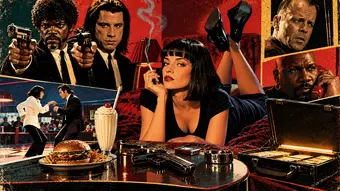
The humour often comes from an argument that goes on longer than needed to resolve a practical matter. That extra time reveals hierarchies, vanity and resistance. The relationship between casual conversation and threat also runs through Pulp Fiction, though there it is spread across different stories and settings. The group gathered under suspicion gives way to more scattered encounters, where a conversation can change its tone without anyone managing to control the consequences.
The opening breakfast scene introduces the men before the urgency of the heist forces them to act. They talk about a song and argue over tipping, matters that seem unrelated to the job they share. Yet the table already shows who dominates the conversation, who challenges a custom and who steps in to end the dispute.
The scene has a work-related dimension: paying or refusing to pay a tip means expressing ideas about service, effort and obligation. The characters want to convince the others. Their arguments show how they defend a position when no weapons have yet decided the disagreement.
This small conflict sets up a contrast with what happens later. Verbal confidence over a meal and the ability to respond to a crisis are not the same thing. When pain and suspicion set in, the same men have to stand by their principles under much more difficult conditions. The opening thus gives us an initial measure of their sociability, before danger changes the meaning of every gesture.