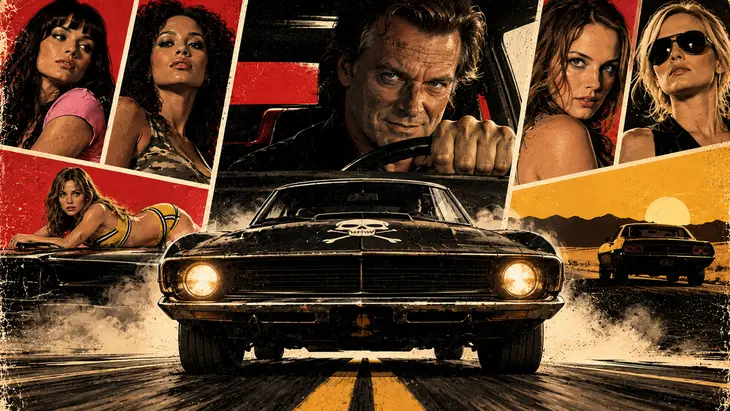
Death Proof combines a killer’s surveillance with conversations among friends and a threat that eventually takes over the road. Stuntman Mike uses his experience as a stunt performer to project an image of control. The groups of women he encounters have their own interests, jobs and relationships, developed through conversations that may seem far removed from danger. The film makes that distance feel unsettling: we know there is a threat while watching people occupied with enjoying their time.
The division into two major sections changes the lighting, the settings and the relationship with the car. The car can be a place to talk, an object of desire or a means of assault. The staging changes its meaning by focusing on who is driving, who is watching and who is exposed. Its origins as part of the double feature Grindhouse add another dimension: the marks of a worn print and shifts in tone evoke a screening experience, while the action needs to remain clear so that each change in distance or speed is easy to follow.
Death Proof follows Stuntman Mike, a film stunt performer who turns his car into a weapon against women. The film devotes long stretches to two groups before bringing their routines into conflict with that threat. The time spent talking lets us recognize their bonds and differences, so the danger’s arrival affects people whose lives extend beyond their encounter with the attacker.
Grindhouse and the form of a found film
The official Cannes presentation explains that Death Proof was released in US theatres as part of Grindhouse, alongside Planet Terror, by Robert Rodriguez, and fake movie trailers. The presence of Death Proof in Grindhouse connects the feature film to the tradition of the exploitation-film double bill. The project plays with the expectation of a screening that delivers thrills, excess and shifts in tone across several features.
The scratches and jumps that imitate a deteriorated print make the image’s physical medium perceptible. Not everything we see seems to belong to a polished, uniform presentation. This look shapes the relationship with the audience: it can prompt a smile, interrupt continuity or reinforce the impression of watching a film recovered from another era.
At the 2007 Cannes press conference, Tarantino explained that the two films had been cut for the double feature and were also intended to be screened separately. The differences between the Grindhouse cut and the extended version stem from those two presentations. The additional material changes how much time we spend with the characters and how some encounters unfold, as well as altering the overall running time.
Two groups and different relationships with risk
The two-act structure of Death Proof moves the action from Austin to Tennessee and replaces one group of protagonists with another. The first part favours nighttime, bars and the persistent presence of a stranger; the second opens the story up to daytime settings and women connected with film work. The threat returns, but encounters different abilities and relationships.
Kurt Russell plays Stuntman Mike, according to the Cannes credits. His performance shifts between familiarity, resentment and an attentiveness that can become intrusive. Mike tries to present himself as someone worth being curious about and uses his professional stories to dominate the conversation. The film maintains an unsettling distance between this apparent sociability and the way he watches the people in front of him.
For the second group, Cannes lists Rosario Dawson as Abernathy, Tracie Thoms as Kim and Zoë Bell as Zoë. The presence of Zoë Bell as a character in Death Proof connects the thrill of risk with professional experience within the fiction. The women’s trust in one another lets them joke, disagree and gauge what each is willing to do. Their differences matter because any shared decision requires someone to accept another person’s initiative.
The film uses the suspense of being stalked and the action of car chases at different paces. It can first prolong our awareness of a threat; then it forces a response through immediate decisions. The car links these two modes: its ability to provide mobility also creates vulnerability when another driver decides to invade the same space.
Cinematography, editing and the sound of movement
The festival listing credits Tarantino as cinematographer on Death Proof and Sally Menke as editor. The camera connects faces, hands, car bodies and the road to make a rapidly changing situation easy to follow. In the final chase in Death Proof, recognizing where each vehicle is lets us anticipate a danger before the next collision.
The framing of an exposed body conveys a different kind of precarity from that of someone protected by a car’s interior. The image communicates effort, balance and resilience, while the editing determines how long a difficulty remains visible. The staging relies on this physical perception: each new obstacle demands an adjustment in movement and makes clear how difficult it is to stay in control.
The Death Proof soundtrack shares space with engines, wind, brakes and impacts that give the action a physical presence. The songs help create leisurely settings and a pleasurable relationship with travel. When the noise of the vehicles becomes more prominent, the road no longer feels like a carefree journey: every audible change can signal proximity, acceleration or a shrinking margin for error.
Mike’s work as a stunt performer connects him to an industry history he feels the need to tell others about. His public identity depends on work done so someone else can appear as the star. Introducing himself through those credits is also a way of demanding attention and recognition, even if the women he speaks to do not necessarily share the references he considers valuable.
The second group introduces a different relationship with that line of work. Film work is part of their current conversations and friendships; it serves as shared experience and practical knowledge. The film thus presents different attitudes towards a similar physical activity. Learning to face risks does not, in itself, determine how someone will treat other people.
That difference means skill is no guarantee of moral character. Mike sees his advantage as a right to dictate the terms of an encounter, while the friends have to negotiate decisions among themselves. Professional recognition, trust and power are connected, but each character uses their abilities within very different relationships. The conflict is about conduct as much as skill.