
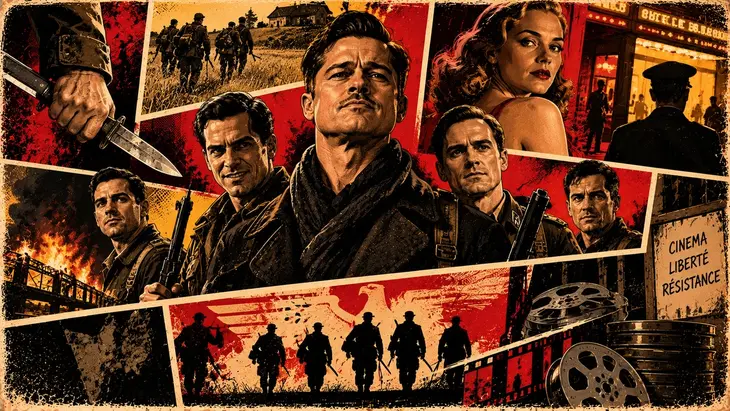
Inglourious Basterds sets several stories of survival, espionage and revenge in Nazi-occupied France. Shosanna Dreyfus tries to build a new life; a group of soldiers seeks to sow fear among their enemies; actors and agents must perform identities that can be exposed by the smallest detail. The film brings these trajectories together around cinema, understood as profession, public spectacle and propaganda tool.
The threat often appears through conversation. Speaking fluently is not enough: accent, the person you are speaking to and the ability to notice what information is being tested all matter. A table can become as dangerous as a battlefield. Tension comes from prolonging the exchange when someone needs to leave or fears that the next question will reveal something. That mechanism sits alongside humour and bursts of violence within a fiction that allows itself to alter history. Historical characters and references to the war are part of a narrative construction whose outcome does not function as testimony to real events.
Inglourious Basterds, titled Inglourious Basterds in its original version, interweaves a personal revenge and an operation against Nazi power. Its setting is occupied France, but its structure belongs to a fiction of alternate history. The presence of historical leaders and circumstances coexists with invented characters and with events conceived to transform that past within the story.
Stories converging around a cinema
The Cannes synopsis presents Shosanna Dreyfus, played by Mélanie Laurent, as a survivor who runs a cinema in Paris. Her position combines vulnerability and capacity for action: she must control what others know about her while managing a place open to the public. The routine of the establishment forces her to deal with people whose attention may become a threat.
Brad Pitt plays Aldo Raine, leader of the group of American Jewish soldiers known as the Basterds. His intimidation strategy unfolds in parallel with Shosanna’s story. The official dossier also introduces actress Bridget von Hammersmark, a collaborator of the Allies, and the British Archie Hicox, a commando with experience as a film critic. Their cultural knowledge proves practically useful within the mission.
The chapter order in Inglourious Basterds distributes attention between these threads. Each shift can leave a threat hanging and take us to a group that does not know what we have just learned. The plans converge without all their participants sharing the same information. That imbalance allows a gesture to have consequences for people who are not even present when it is made.
Languages and courtesy under pressure
Christoph Waltz plays Hans Landa, an officer whose powers of observation emerge through questions and apparent courtesy. Cannes awarded him the Best Actor prize in 2009 for this role. The performance makes it hard to separate social politeness from calculation: a smile can ease the conversation for a moment and, at the same time, prolong control over the person answering.
The opening scene of Inglourious Basterds organises that relationship around a visit and a conversation. The time devoted to manners makes the imbalance between host and guest all the more uncomfortable. The danger does not need to be expressed in every sentence because the situation already establishes who can ask questions and who must weigh the consequences of answering them.
The languages as a weapon in Inglourious Basterds make it possible to include or exclude a listener and to check whether someone can carry off the role they are playing. The difference between understanding a language and passing as a speaker from a particular place becomes decisive. An accent, a cultural reference or a reaction can make an apparently solid identity begin to seem doubtful.
In the tavern in Inglourious Basterds, the shared space and proximity of other customers make it difficult to control the encounter. The conversation has to continue even when it ceases to be comfortable. This use of questions, pauses and tests connects with Tarantino’s dialogue and narrative structure: verbal exchange can be the main action of a scene and alter its possible outcome.
Propaganda, spectacle and the power of images
Pride of the Nation is a propaganda film within the fiction. Its screening brings together political interests, personal prestige and the organisation of the spectacle. Cinema takes on several simultaneous functions: it allows a heroic image to be presented, gathers an audience and requires material work for the screening to take place. Shosanna knows this process from the inside.
The 2009 Cannes entry credits Robert Richardson for cinematography, David Wasco for production design and Sally Menke for editing. The staging links spaces of performance and work areas: an auditorium, an entrance and a projection booth allow different sides of the same event to be seen. The alternation between them broadens what the audience knows and keeps the characters’ knowledge separate.
The Inglourious Basterds soundtrack accompanies shifts between threat, preparation and spectacle. Music can lend solemnity to an entrance or make the emotional impulse behind a decision visible. The effect forms part of Tarantino’s cinematic genres and homages, where verbal duels, espionage and war adventure provide different means of sustaining the same tension.
Personal revenge and military operation do not stem from the same motivation, even though both are aimed against Nazi power. The film preserves that difference between private experience and collective strategy. Its intersections give cinema a central place: it is the site where images promise authority and where others try to dispute who controls the representation of what has happened.
The production dossier identifies as a precedent for the title a 1978 film by Enzo G. Castellari, internationally known as The Inglorious Bastards. Castellari himself distinguishes between the stories and explains that Tarantino’s work is not a remake of his. The relation of the name to another film belongs to the dialogue between cinematic traditions.
Tarantino’s original title, Inglourious Basterds, preserves a particular spelling in both words. That form identifies a specific work and accompanies its appropriation of a war-adventure image. The Spanish title, Malditos Bastardos, keeps the emphasis on a group defined by a defiant identity.
Within the story, names and reputations also come before people. A nickname can spread fear, while a professional identity can grant access to a place or arouse interest. The title takes part in that importance given to the way one presents oneself to others: it promises a story of fighters, even though the film divides its attention between soldiers, a cinema owner and people acting under different identities.