The Hateful Eight turns a mountain refuge into a place where every introduction needs to be questioned. Its occupants share an immediate need—to protect themselves from the storm—but arrive with interests and memories that make living together difficult. The shelter allows them to survive the cold and, at the same time, forces them to stay close to people who could become a threat.
The film brings together elements of the Western and the locked-room mystery. The characters talk about rewards, official positions and military pasts to establish who deserves obedience and who can demand explanations. That dispute takes up as much space as the guns. A confident voice can persuade, intimidate or conceal a contradiction; listening means deciding which parts of a story seem credible.
The expanse of the opening landscape gives way to an increasing focus on positions within a room. Glances, distances and small changes in behaviour sustain an atmosphere of watchfulness. Harsh humour and bursts of violence disrupt the waiting without offering a morally comfortable figure from whom to judge everyone else. Distrust affects both the people and the way they try to explain the world.
Released in 2015, The Hateful Eight is set in Wyoming after the Civil War. A stagecoach is headed for Red Rock as a blizzard approaches. The journey brings several strangers together and eventually takes them to Minnie’s Haberdashery, where other travellers are already sheltering.
Characters vying for authority
The cast list compiled by the BFI identifies Kurt Russell as John Ruth and Jennifer Jason Leigh as Daisy Domergue. He is the bounty hunter transporting her as a prisoner; she is kept under watch, which also determines how she can move. Their physical proximity makes their actions inseparable: Daisy’s reaction can contradict the confidence with which Ruth addresses the others. Controlling someone’s body does not guarantee understanding what that person sees or expects.
Samuel L. Jackson plays Major Marquis Warren, a former Union soldier and bounty hunter. Walton Goggins is Chris Mannix, who introduces himself as the new sheriff of Red Rock. The identities they claim bring the war and racism into an apparently practical negotiation about the journey. Knowing who held an office or which side someone belonged to does not let you predict their next decision. Those present have to recognize someone’s authority, and that recognition is constantly disputed.
The ensemble is organized through differences in voice, posture and patience. Some characters demand attention with a lengthy story, while others seem content to listen from a corner. Unequal speaking time does not mean unequal importance. Someone who remains silent can shape a conversation because the others do not know what they have understood or whom they distrust. The film makes watching the listeners just as important as following the speaker.
The refuge and the management of information
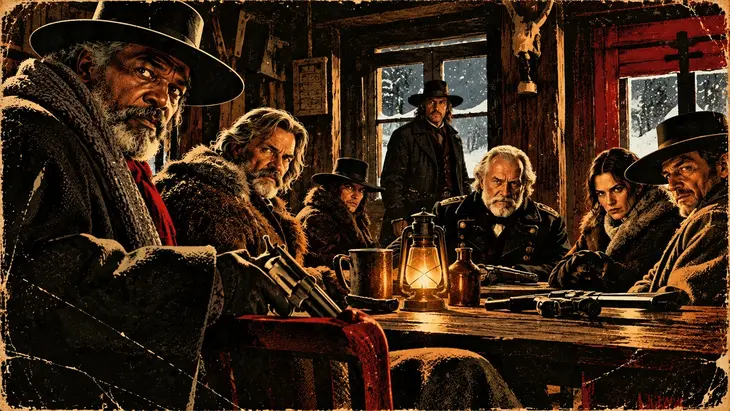
Minnie’s Haberdashery offers food, warmth and rest—ordinary comforts that the situation makes problematic. Sharing a table or moving among the furniture means accepting proximity that no one fully controls. The storm limits the available exits and makes it difficult to walk away from an argument. The place looks ordinary, but its use becomes tactical; changing position alters who can see, hear or interrupt someone else.
The chapter divisions regulate access to the past and to events beyond some characters’ knowledge. The narrative does not provide all the information at once or from a consistent point of view. When a new detail emerges, viewers have to reconsider the trust they placed in an earlier explanation. That reassessment is part of the suspense: it matters what happens, but also why one version seemed persuasive.
Objects take on significance when they shift from everyday use to the centre of an argument. An item can serve as a sign of status; a claim about it can demand trust. The film lets us read these exchanges as a dispute between evidence, stories and reputations. Not everything said is confirmed, and an impassioned speech is not enough to make it a reliable account. The dark humour makes this uncertainty uncomfortable, because it can make us laugh while someone tries to assert their power.
A wide format for a confined space
American Cinematographer’s report on the shoot documents the use of 65 mm negative and 70 mm projection prints, with an aspect ratio of 2.76:1. In The Hateful Eight in Ultra Panavision 70, the width allows several figures to remain in the frame at once. One face can draw attention while another body remains visible some distance away. The format therefore offers a way to observe relationships, as well as to show the expanse of the landscape.
Morricone’s score for The Hateful Eight sustains a sense of threat that can precede any visible aggression. The Academy of Motion Picture Arts and Sciences recorded its Original Score Oscar win at the 2016 ceremony. The music shares the space with voices, wind and sounds from the establishment: danger also belongs to the environment we hear while the camera stays inside. The sounds of waiting do not need to immediately signal who poses a threat.
The versions of The Hateful Eight affect how a screening is organized. American Cinematographer documents the roadshow presentation, with an overture and intermission, and a shorter subsequent theatrical release. Image format and editing are related but different matters: retaining a wide frame does not, on its own, prove which version is being watched. A scheduled intermission also shapes the experience of a story built around waiting.
The word “justice” changes meaning depending on who says it in The Hateful Eight. A character can invoke an office, a reward or a procedure to present what they want to do as legitimate. The film invites us to notice the distance between that justification and the actual behaviour. Speaking on behalf of an institution does not erase the speaker’s personal interest.
This conflict lets us consider how the group lives together without drawing a fixed equivalence between each figure and a political idea. The characters arrive with histories and prejudices, but their alliances also respond to immediate needs. A temporary alignment of goals can bring people closer even as they continue to despise one another. Cooperation does not automatically erase what divides them.
That mixture is the source of the moral discomfort. The story gives us reason to distrust opposing arguments and shows how humiliation can accompany a supposed defence of order. Judging an action means paying attention to who has power, what choices each person can make and what consequences they impose on others. The rhetoric of the law and the experience of being subject to it do not always coincide.