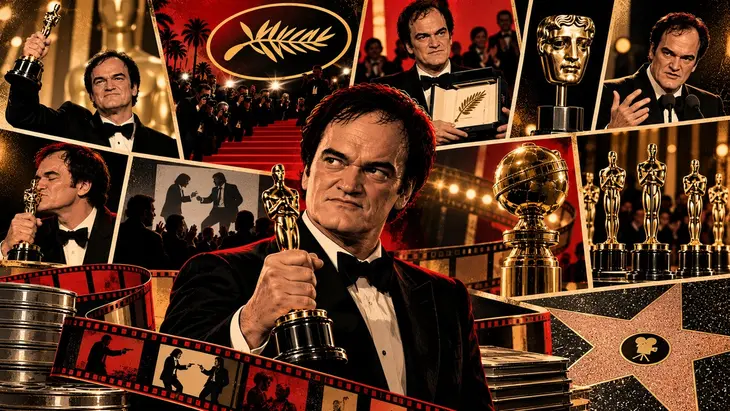
Quentin Tarantino appears in award records for different kinds of work. Writing and directing a film allow him to compete in separate categories, with results that can vary from one ceremony to another. For a Best Picture nomination, the institution identifies the credited producers. To understand his award record, the category matters as much as the award-winning title: it identifies what work is being recognized and who receives the recognition.
Cast awards are part of the history of his films, although they belong to the performers who receive them. The same is true of cinematography and production design awards. Attributing them all to the director erases the contributions of people whose work was assessed separately.
Tributes have a different scope. They can recognize a career or an enduring relationship with film culture, without selecting one film over others from a particular season. Their significance depends on the institution presenting them and the reason for the honour. That information makes it possible to compare recognitions without reducing them to a single trophy count.
The Oscars: writing, nominations and team awards
At the 67th Academy Awards in 1995, Pulp Fiction won the award for Original Screenplay. The Academy distinguishes the contributions of its two award recipients: screenplay by Quentin Tarantino and story by Tarantino and Roger Avary. Tarantino was also nominated for directing, a category won by Robert Zemeckis for Forrest Gump. The writing win and the directing nomination are different results from the same edition.
The second of Tarantino’s Oscars for screenwriting came at the 85th Academy Awards in 2013, for Django Unchained. The Academy’s record identifies Tarantino as the writer of the original screenplay. The film also won the award for Supporting Actor for Christoph Waltz. Both recognitions are connected to the same production, but they have different recipients and categories; Waltz’s win was for his performance.
At the 92nd Academy Awards in 2020, Tarantino was nominated for directing and Original Screenplay for Once Upon a Time in Hollywood. He was also nominated for Best Picture as a producer, alongside David Heyman and Shannon McIntosh. He did not win in those categories. The film’s awards went to Brad Pitt for Supporting Actor and to Barbara Ling and Nancy Haigh for Production Design. The Academy specifies the roles of the latter two: Ling was the production designer, and Haigh was the set decorator.
Cannes, BAFTA and the Golden Globes
The Palme d’Or for Pulp Fiction was awarded at Cannes in 1994. The festival archive notes that the jury was presided over by Clint Eastwood. The award went to the film entered in competition; this category is not the same as a specific directing or screenwriting award. This distinction explains why the Palme and the writing Oscar record different recognitions for the same work, without either replacing the other.
The Golden Globes archive records three wins for Tarantino in Best Screenplay: Pulp Fiction in 1995, Django Unchained in 2013 and Once Upon a Time in Hollywood in 2020. In all three cases, the recipient was the screenwriter. He was also nominated for directing at those same ceremonies, but did not win. Even within a single institution, the result in one category does not determine the result in another; a nomination identifies the final selection, not a win.
On February 10, 2013, BAFTA announced the award for Original Screenplay for Django Unchained as going to Tarantino. The directing award that year went to Ben Affleck for Argo. The record of the Golden Globes and BAFTA thus shows agreement between institutions on a screenplay, alongside different decisions in other categories. The results document a specific reception; on their own, they do not explain how each member voted or allow motives to be attributed to them if they have not stated those motives.
Career tributes and jury presidencies
The Lumière Festival in Lyon presented Tarantino with its award in 2013. The official announcement linked the selection to his films and his cinephilia, including his interest in other filmmakers and performers. It recognized a relationship with cinema that went beyond a particular release. This kind of tribute places Tarantino’s professional career in the context of an institution that celebrates both the works he has made and his work as a filmgoer and champion of other people’s films.
The Hollywood Chamber of Commerce dedicated a star to him on the Hollywood Walk of Fame on December 21, 2015, in the Motion Pictures category. Among the honours recognizing his career, the star is distinct from an annual screenplay award. Its inscription identifies the honouree and a branch of professional activity; it does not designate a winning film or a specific performance.
Tarantino’s role as a jury president must be distinguished from his award record. At Cannes in 2004, he presided over the feature film jury, according to the festival archive. His role was to take part in assessing the films in that edition. The awards presented by that jury belong to their recipients. His presidency documents a responsibility within the festival and should be recorded as such when reconstructing his relationship with Cannes.
The year of an awards ceremony may come after the year of the films it recognizes. The 2020 Oscars took place on February 9 and honoured films released in 2019, as the Academy itself notes. That is why Once Upon a Time in Hollywood is associated with 2019 in a filmography and with 2020 in the award record.
The same distinction applies to Django Unchained: the 2013 ceremony took place on February 24 and recognized films released in 2012. The year identifying the work and the year of the award refer to different things. Changing one to the other would shift the award in the chronology.
When consulting an abbreviated record, it is useful to keep both dates. It is also worth checking whether the heading refers to the nominations announcement or the final awards ceremony, since these are separate moments in a season. A news story published before the ceremony can confirm a nomination; to establish the result, consult the final awards record for that edition.