Quentin Tarantino’s beginnings combine a viewer’s curiosity with learning a craft. Watching a film can help you remember a face, a scene or a way of telling a story; preparing to act means working out what a character wants and how they respond to others. Making a film brings other challenges: having a camera, coordinating the participants and ensuring the footage holds together. These experiences call for different kinds of attention.
During his formative years, these activities were closely connected. Classes offered fellow students and opportunities to work on scenes; his job at a video store brought him into daily contact with films and film enthusiasts; and his early attempts at filmmaking let him test ideas with limited resources. Each setting provided a specific experience, without being, on its own, a complete explanation of his later films.
Accounts from Tarantino and those who worked with him let us follow this process from several points of view. His acting training, conversations about films and collaborations on film shoots help explain how he took on responsibilities before entering professional feature filmmaking.
The period before his first releases included activities that took place at the same time. Earning a living, preparing an acting scene and writing a screenplay could occupy different moments in the same phase of his life. He learned through these practices and through encounters that led to shared projects.
California, movie theatres and acting classes
In her October 2003 profile for The New Yorker, Larissa MacFarquhar places Tarantino’s childhood in the Manhattan Beach area, south of Los Angeles. His California roots help locate the places he later describes as a filmgoer.
In his Fresh Air interview of August 27, 2009, preserved in the programme’s archive, Tarantino recalled that around the age of 13 or 14, he began going to the movies more often. He combined Hollywood releases with exploitation films and European cinema he found at other theatres. His experience as a viewer thus included different exhibition circuits.
Acting was a professional aspiration. In his conversation with Charlie Rose on December 26, 1997, he explained that it had been his first way into show business and the focus of his studies. Tarantino’s acting classes came before his recognition as a director. Rehearsing a role means turning a text into actions and reactions—a different practice from remembering how someone else performed it in a film.
Speaking with Terry Gross in that 2009 interview, he recalled his time at a community theatre in Torrance and his later classes with James Best. There, he learned on-camera acting and film-set terminology. His account links this training to his growing interest in directing, as he wanted to have a hand in the film beyond appearing in it.
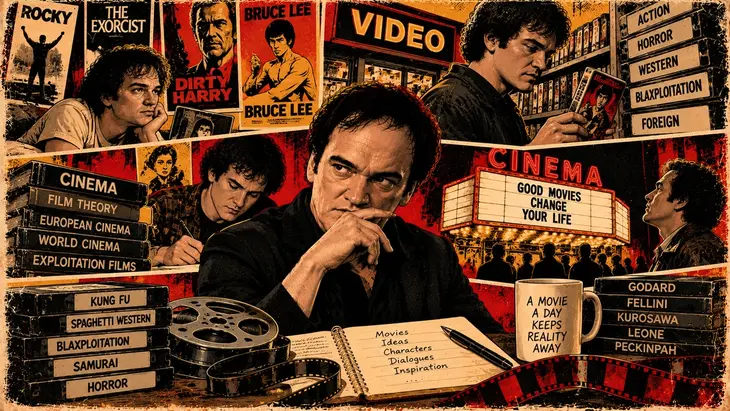
Jobs and film exchanges at Video Archives
Biography notes that he worked as an usher at an adult movie theatre and later at Video Archives, alongside Roger Avary. These early film-related jobs put him in contact with moviegoers: at the theatre he welcomed the audience, and at the video store he handled film rentals.
The Video Archives video store offered a place to talk about what others were about to watch or had just returned. These conversations invite very specific questions: what kind of film someone is looking for, what they liked about another one and why they might enjoy a different choice. A recommendation means translating personal enthusiasm into an explanation another person can understand. This exchange takes place around available copies and tastes that may differ.
Talking about films and preparing to make them involve different tasks. Knowing how to explain why a scene works does not yet solve the problem of filming it with your own crew. To do that, you have to choose a location, prepare the performers and decide what to capture. The video store could bring together people with common interests; shared projects required them to turn those conversations into work.
The experience of filming with Craig Hamann
Craig Hamann recalled in an interview published by Trainwreck’d Society on February 3, 2020, that he and Tarantino had become friends at James Best’s school. According to his account, the two conceived and made My Best Friend’s Birthday. Hamann describes a shared initiative and a demanding learning experience during the shoot. His involvement helps us understand the project as a collaboration from the outset.
Hamann also specified that they used a 16 mm Bolex borrowed from Fred Olen Ray. This detail highlights a material condition of the work: access to equipment depended on someone else’s help. A borrowed camera made it possible to capture the scenes, but preparation, acting and continuity still had to be worked out. Filming meant coordinating these tasks as part of a single experience.
Larissa MacFarquhar’s profile, published in The New Yorker in October 2003, places this attempt at making a film in the mid-1980s and explains that it was abandoned. Years later, Sundance’s records document the directing lab in 1991 and the presentation of Reservoir Dogs at its 1992 festival. Tarantino’s professional career began after an earlier period of writing and filmmaking that had already required collaborators.
Acting classes also provided an opportunity to start writing scenes. On Fresh Air, Tarantino explained in 2009 that he prepared material to perform in class and filled in from memory the passages he could not recall. Sometimes he added his own dialogue. The immediate need was to have a scene he could work on as an actor, before thinking of that writing as an activity with value in its own right.
This exercise reveals a practical connection between acting and writing. A line has to be speakable to another person, prompt a response and sustain the situation. Performing a text raises questions that can go unnoticed during silent reading: where a pause is needed, what information is clear and what reaction a line is setting up. Learning happens by hearing the material in action. In this case, a task connected to rehearsal also offered a chance to test the timing and effect of the words in front of other people.