Inglourious Basterds sets several stories of survival, espionage, and revenge in Nazi-occupied France. Shosanna Dreyfus tries to build a new life; a group of soldiers seeks to spread fear among its enemies; actors and agents must perform identities that can be exposed by the smallest detail. The film brings these storylines together around cinema, understood as a profession, a public spectacle, and a tool of propaganda.
The threat often emerges through conversation. Speaking fluently is not enough: the accent, the person being addressed, and the ability to notice what information is being tested all matter. A table can become as dangerous a place as a battlefield. Tension builds as an exchange continues when someone needs to leave or fears the next question will reveal something. This device coexists with humour and bursts of violence in a work of fiction that allows itself to alter history. The historical figures and references to the war are part of a narrative construction whose ending is not a record of real events.
Inglourious Basterds, titled Inglourious Basterds in its original version, weaves together a personal revenge plot and an operation against Nazi power. Its setting is occupied France, but its structure belongs to an alternate-history fiction. Historical leaders and circumstances coexist with invented characters and events designed to transform that past within the story.
Stories that converge around a cinema
The Cannes synopsis presents Shosanna Dreyfus, played by Mélanie Laurent, as a survivor who runs a cinema in Paris. Her position combines vulnerability with agency: she must control what others know about her while managing a place open to the public. The day-to-day running of the cinema requires her to deal with people whose attention can become a threat.
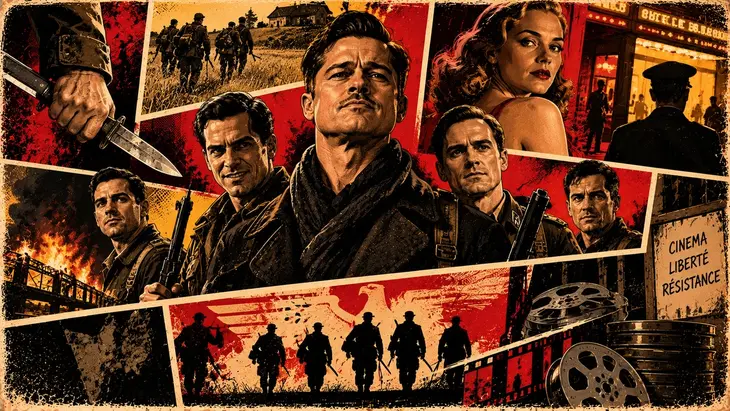
Brad Pitt plays Aldo Raine, who leads the group of American Jewish soldiers known as the Basterds. His strategy of intimidation unfolds alongside Shosanna’s story. The official press kit also introduces actress Bridget von Hammersmark, an Allied collaborator, and Briton Archie Hicox, a commando with experience as a film critic. Their cultural knowledge has a practical purpose in the mission.
The order of the chapters in Inglourious Basterds shifts the focus among these storylines. Each change can leave a threat unresolved and take us to a group unaware of what we have just learned. The plans converge without all the participants sharing the same information. This imbalance means that a gesture can have consequences for people who are not even present when it happens.
Languages and courtesy under pressure
Christoph Waltz plays Hans Landa, an officer whose powers of observation are expressed through questions and apparent courtesies. Cannes awarded him the Best Actor prize in 2009 for this role. The performance makes it difficult to separate social charm from calculation: a smile can ease the conversation for a moment and, at the same time, prolong the control exerted over the person answering.
The opening scene of Inglourious Basterds builds this relationship around a visit and a conversation. The time devoted to manners makes the imbalance between host and guest more uncomfortable. The danger does not need to be voiced in every sentence because the situation has already established who can ask questions and who must weigh the consequences of answering them.
The use of languages as a weapon in Inglourious Basterds can include or exclude a listener and test whether someone can convincingly play the role they are portraying. The difference between understanding a language and passing as a speaker from a particular place becomes crucial. An accent, a cultural reference, or a reaction can make an apparently solid identity begin to seem doubtful.
In the tavern in Inglourious Basterds, the shared space and the proximity of other patrons make it difficult to control the encounter. The conversation must continue even when it becomes uncomfortable. This use of questions, pauses, and tests connects with Tarantino’s dialogue and narrative structure: the verbal exchange can be the main action in a scene and change the chances of getting out.
Propaganda, spectacle, and the power of the image
Nation’s Prideis a propaganda film within the fiction. Its screening brings together political interests, personal prestige, and the organization of a spectacle. Cinema takes on several functions at once: it presents a heroic image, draws an audience, and requires hands-on work to make the screening happen. Shosanna knows how it works from the inside.
The 2009 Cannes film record credits Robert Richardson for cinematography, David Wasco for production design, and Sally Menke for editing. The staging links spaces of representation with work areas: a theatre, an entrance, and a projection booth offer different views of the same event. Moving between them broadens what the viewer knows while keeping the characters’ knowledge separate.
The soundtrack of Inglourious Basterds accompanies shifts between threat, preparation, and spectacle. Music can lend solemnity to an entrance or make the emotional force of a decision visible. This effect is part of Tarantino’s film genres and homages, where verbal duels, espionage, and war adventure offer different ways to sustain the same tension.
Personal revenge and the military operation do not stem from identical motives, even though both target Nazi power. The film preserves this distinction between intimate experience and collective strategy. Their intersections give cinema a central role: it is where images promise authority and where others try to wrest control of the representation of what happened.
The production notes identify a 1978 film by Enzo G. Castellari as the title’s predecessor, known internationally as The Inglorious Bastards. Castellari himself distinguishes between the stories and explains that Tarantino’s work is not a remake of his film. The name’s connection to another film belongs to a dialogue between cinematic traditions.
Tarantino’s original title, Inglourious Basterds, retains a distinctive spelling in both words. This form identifies a specific work and accompanies its appropriation of the imagery of war adventure. The Spanish title, Malditos Bastardos, maintains the emphasis on a group defined by a defiant identity.
Within the story, names and reputations also precede the people themselves. A nickname can spread fear, while a professional identity can provide access to a place or attract interest. The title reflects the importance given to how people present themselves to others: it promises a story about fighters, even though the film also focuses on soldiers, a cinema owner, and people acting under different identities.