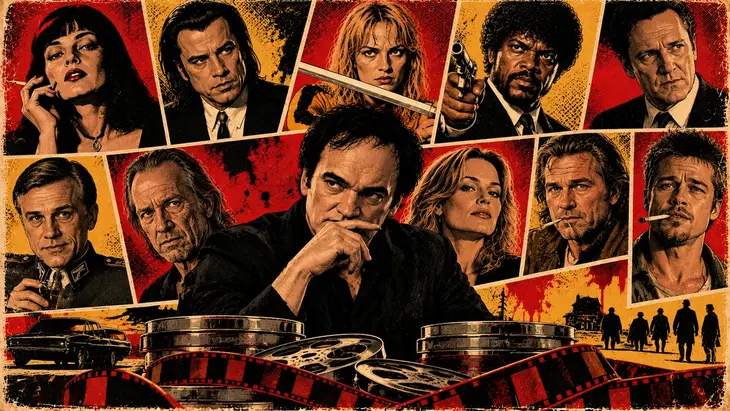
Actors who return to Tarantino’s films often find themselves playing characters in different positions within the story. An actor may wield authority in one film and depend on other people’s decisions in the next. Comparing those roles reveals changes that a list of appearances leaves out: who needs help, who sets the terms and what happens when they lose control.
The recurring cast spans films from different genres and eras. The same face might be familiar from a contemporary crime story, then appear in a western. That familiarity shapes the first impression, but each character needs to establish their own relationships. Recognising the actor lets us compare their roles; connections between fictional characters require information from the stories.
The significance of an appearance can also vary. A role might carry an entire film, form part of a leading pair or feature in a brief episode. Duration alone explains little: a supporting character might solve a problem that occupies the leads, or introduce a difficulty that changes the rest of the story.
Cannes credits Pulp Fiction with actors who went on to work with Tarantino again, including Samuel L. Jackson and Uma Thurman. Their later collaborations let us compare more than the persistence of certain names: the characters change, as do the casts they interact with and the roles they play in the conflict.
Roles that change the relationship with power
Christoph Waltz plays Hans Landa in Inglourious Basterds and King Schultz in Django Unchained, according to the Cannes and Sony credits. Landa uses conversation to investigate and dominate the people he interrogates. Schultz puts his negotiating skills to work in an alliance with Django. Their courtesy has different effects: in one case, it prolongs a threat; in the other, it makes it possible to negotiate access to a place or propose a deal.
Leonardo DiCaprio goes from plantation owner Calvin Candie in Django Unchained to actor Rick Dalton in Once Upon a Time in Hollywood. Sony identifies both roles. Candie expects visitors to adapt to his terms; Rick needs to convince others that he can still do a job. The difference is apparent in their relationship with approval: one has people obliged to please him, while the other depends on casting decisions he cannot control.
The BFI credits Samuel L. Jackson as Ordell Robbie in Jackie Brown. Sony identifies him as Stephen in Django Unchained. Ordell tries to protect a criminal operation; Stephen keeps watch over what happens inside Candie’s house. Their ways of exercising influence depend on their different positions. The first gives orders as the person in charge of an operation; the second knows how a household works and uses that knowledge to intervene.
Keitel and Madsen’s experience in different roles
Harvey Keitel plays Mr White in Reservoir Dogs, as listed in the AFI catalogue, and Mr Wolf in Pulp Fiction. White gets involved in protecting an injured colleague and lets that relationship compromise his judgement. Mr Wolf arrives to organise the solution to a practical problem. Both speak with the authority of experience, but White’s emotional involvement unsettles an authority that Mr Wolf can exercise with greater detachment.
Michael Madsen plays Mr Blonde in Reservoir Dogs and Budd in Kill Bill Vol. 2; the AFI and Cannes list those credits. Blonde turns his calmness into a threat to others. Budd is tied to a violent past that weighs on his present circumstances. The actor’s familiarity lets us compare two ways of introducing danger, without suggesting that the characters are the same just because some of their gestures are similar.
From the centre of the story to ensemble work
Uma Thurman occupies very different roles as Mia Wallace in Pulp Fiction and the Bride in Kill Bill. Mia carries much of an episode through her relationship with Vincent. The Bride’s quest drives both volumes and structures her encounters with her adversaries. This change in scale requires emotional continuity across a much wider range of situations. Cast preparation and actor direction explore the working decisions that help shape each role.
Cannes identifies Brad Pitt as Aldo Raine in Inglourious Basterds; Sony credits him as Cliff Booth in Once Upon a Time in Hollywood. Aldo leads a group of soldiers and needs to ensure they act on his orders. Cliff works as Rick Dalton’s stunt double and shares much of his routine. Their positions within a pair or a group change what each character needs to resolve, even though both roles draw on the actor’s physical confidence.
Tim Roth appears again in The Hateful Eight as Oswaldo Mobray, according to the BFI, after playing Mr Orange in Reservoir Dogs. Orange spends much of the story immobilised by an injury; Mobray takes part in conversations among the group gathered at Minnie’s. Their opportunities to intervene in the scene differ. The recurring cast lets us trace these differences across Quentin Tarantino films, without reducing each return to a repeat of the previous role.
Counting collaborations requires deciding what is being counted. An on-screen appearance, a voice role and stunt work are different kinds of participation. Credits identify the role, while the length of a scene helps describe its scope. Combining all these tasks into a single figure can obscure useful differences.
Kill Bill raises another question: its story was released in two volumes. A list of films might record each part separately, while a description of the collaboration treats the project as a whole. The comparison is clearer when the same criteria are applied to everyone and it specifies which instalment each role appears in.
The selection of works also changes the result. Appearing in a film written by Tarantino and directed by another filmmaker is a different kind of professional relationship. Separating films he directed, scripts written for other directors and productions makes it possible to locate each credit without attributing every work associated with his name to Tarantino as director.